Guide
Best Mattress for Sciatica Pain: Expert Sleep Guide (2026)
Find the best mattress for sciatica pain relief. Expert tips on firmness, side sleeping, spinal alignment, and top-rated picks to reduce nerve pain.
By Sciatica Spot Editorial Team
If you suffer from sciatica, your mattress could be making the pain worse — or better. A mattress that properly supports spinal alignment, cushions pressure points, and distributes body weight evenly can dramatically reduce sciatic nerve irritation during sleep. In this guide, we break down how mattress construction affects sciatica, rank the 7 best mattresses for sciatica relief in 2026, and share sleeping position strategies so you can finally wake up without that radiating leg pain.
Featured Snippet: The best mattress for sciatica is a medium-firm model (around 6–7 on the firmness scale) that supports neutral spinal alignment while cushioning the hips and shoulders. Our top pick for 2026 is the Saatva Classic for its lumbar-zone support and innerspring responsiveness, though the Purple Hybrid is the best choice for hot sleepers with sciatica, and the Casper Wave Hybrid excels for side sleepers who need targeted pressure relief.
Table of Contents
- How Your Mattress Affects Sciatica Pain
- What to Look for in a Mattress for Sciatica
- Firmness Guide: Why Medium-Firm Wins
- Top 7 Best Mattresses for Sciatica (2026)
- Mattress Comparison Table
- Best Sleeping Positions for Sciatica Sufferers
- How to Set Up Your Sleep Environment for Sciatica Relief
- FAQ: Best Mattress for Sciatica
- Sources
How Your Mattress Affects Sciatica Pain
Sciatica occurs when the sciatic nerve — the longest nerve in the human body, running from the lower back through the hips and down each leg — becomes compressed or irritated. The most common culprits are herniated discs, spinal stenosis, piriformis syndrome, and degenerative disc disease. While daytime activities like sitting and lifting often get the blame, the reality is that you spend roughly one-third of your life in bed, and a poorly suited mattress can sustain or worsen the mechanical problems that trigger sciatic flare-ups.
Spinal Alignment
When your spine is not held in a neutral position during sleep, the lumbar vertebrae can shift out of alignment, placing additional pressure on the intervertebral discs and the nerve roots that form the sciatic nerve. A mattress that sags in the middle lets the pelvis sink too far, creating an exaggerated lumbar curve. Conversely, a mattress that is too firm forces the spine into an unnaturally flat position, compressing the disc spaces. Either scenario can aggravate existing sciatica or contribute to new episodes.
Research published in The Lancet found that patients with chronic low back pain who slept on medium-firm mattresses reported significantly less pain and disability than those on firm mattresses after 90 days (Kovacs et al., 2003). This finding has been supported by subsequent studies and remains a cornerstone recommendation from physiotherapists and spine specialists.
Pressure Points
The hips and shoulders are the primary pressure points during sleep. If a mattress does not adequately cushion these areas, the resulting pressure can restrict blood flow, cause muscle tension in the gluteal and piriformis regions, and indirectly increase sciatic nerve irritation. This is especially relevant for side sleepers, whose hip and shoulder bear a concentrated load. Memory foam and hybrid mattresses tend to excel in pressure relief because their conforming layers cradle bony prominences while maintaining core support.
If you are already working on strengthening the muscles around your sciatic nerve, pairing targeted sciatica exercises with a supportive mattress creates a comprehensive approach to long-term relief.

Motion Transfer and Sleep Disruption
Sciatica pain frequently causes restless sleep and the need to change positions throughout the night. If you share a bed, a mattress with poor motion isolation means your partner's movements can jolt you awake — right into a painful position. Foam and hybrid mattresses with individually wrapped coils typically perform best in this category.
What to Look for in a Mattress for Sciatica
Choosing a mattress for sciatica is not just about firmness. Several construction features directly influence whether a mattress will help or hurt your symptoms.
Zoned Lumbar Support: Some mattresses feature a reinforced midsection — firmer foam or additional coils in the lumbar zone — that prevents the pelvis from sinking while allowing the shoulders to settle naturally. This is one of the most important features for sciatica sufferers because it directly maintains the neutral lumbar curve that takes pressure off the sciatic nerve roots.
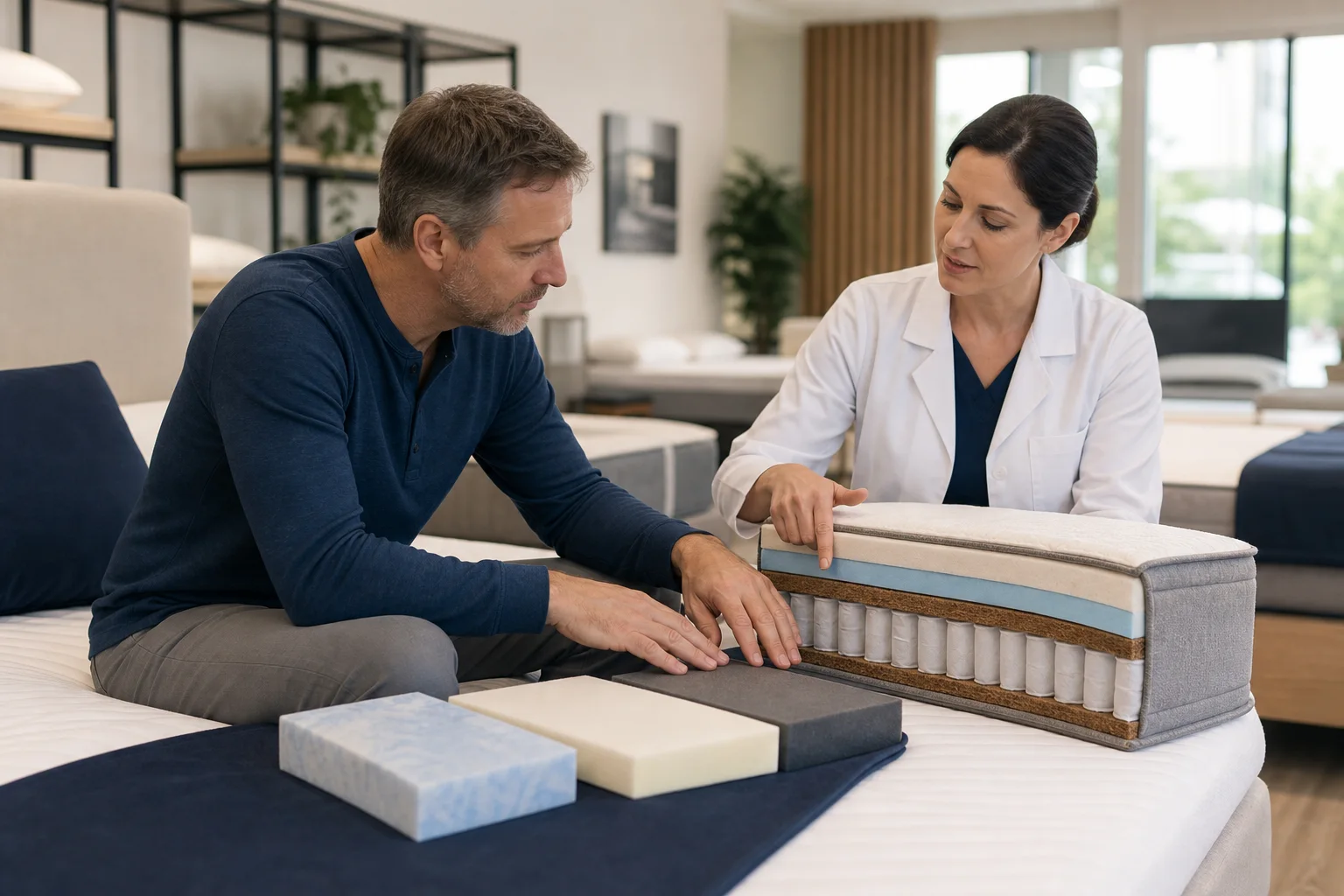
Conforming Comfort Layers: Look for at least 2–3 inches of memory foam, latex, or gel-infused foam in the comfort layer. These materials contour to your body's curves, reducing point pressure on the hips and lower back. Thin comfort layers on top of a hard support core will not provide adequate cushioning.
Responsive Support Core: Whether the core uses pocketed coils, high-density polyfoam, or latex, it needs to push back against your body weight to prevent excessive sinkage. Pocketed coil systems are generally preferred for heavier individuals because they maintain support better over time than all-foam constructions.
Edge Support: If you tend to sleep near the edge of the bed or sit on the side to get up, reinforced edges prevent the sensation of rolling off and ensure consistent support across the full sleep surface. This is particularly relevant for sciatica patients who may need to carefully position themselves at the mattress edge to get in and out of bed without triggering pain.
Temperature Regulation: Pain sensitivity increases when the body is overheated. Innerspring and hybrid mattresses tend to sleep cooler than all-foam models because air circulates through the coil layer. If you run hot, prioritize mattresses with breathable covers, gel-infused foams, or open-cell foam constructions.

Firmness Guide: Why Medium-Firm Wins
Mattress firmness is measured on a scale of 1 to 10, where 1 is the softest and 10 is the firmest. For most sciatica sufferers, the sweet spot falls between 6 and 7 out of 10 — the medium-firm range.
Here is why medium-firm consistently outperforms other firmness levels for sciatica:
- Soft mattresses (3–5): Allow the pelvis to sink too deeply, creating a hammock effect that hyperextends the lumbar spine. This increases disc pressure and can compress the nerve roots responsible for sciatica. While they feel comfortable initially, soft mattresses tend to worsen sciatica symptoms overnight.
- Medium-firm mattresses (6–7): Strike the ideal balance between support and pressure relief. The pelvis is supported enough to maintain a neutral spine, while the comfort layers conform to body contours and relieve pressure on the hips and shoulders. Clinical research consistently supports this firmness range for back pain and sciatica.
- Firm mattresses (8–10): Do not allow sufficient contouring, creating pressure points at the hips and shoulders that can cause muscle tension and indirect sciatic nerve irritation. Firm mattresses are occasionally recommended for stomach sleepers, but most sciatica patients should avoid them.
Body weight matters. If you weigh over 230 lbs, you will compress the comfort layers more deeply, so a mattress rated medium-firm by the manufacturer may feel closer to medium for you. In that case, look for models specifically designed for heavier sleepers or choose mattresses on the firmer end of the medium-firm range (closer to 7). If you weigh under 130 lbs, a mattress rated as medium (around 5–6) will likely provide the same proportional support and pressure relief that a medium-firm mattress gives an average-weight sleeper.

Top 7 Best Mattresses for Sciatica (2026)
After evaluating dozens of mattresses against the criteria above — spinal alignment, pressure relief, lumbar support, temperature regulation, and clinical evidence — here are our top 7 picks for sciatica sufferers in 2026.
1. Saatva Classic — Best Overall for Sciatica
The Saatva Classic remains the gold standard for sciatica relief because of its dual-coil construction and dedicated lumbar support system. The mattress features a Euro pillow top with memory foam, a micro-coil comfort layer for responsive pressure relief, and a base of individually wrapped coils with a reinforced lumbar zone. This combination keeps the spine in neutral alignment regardless of sleeping position while providing enough cushioning to relieve hip and shoulder pressure.
Available in three firmness levels — Plush Soft (3), Luxury Firm (6), and Firm (8) — the Luxury Firm option is the ideal choice for most sciatica patients. The coil-on-coil design also promotes excellent airflow, making it a strong choice for hot sleepers. Saatva offers free white-glove delivery and a 365-night trial, giving you nearly a full year to assess its impact on your sciatica symptoms.
Pros:
- Dedicated lumbar zone support technology
- Excellent edge support for easy bed entry/exit
- Three firmness options in one model
- 365-night home trial with free returns
Cons:
- Heavier than foam mattresses, harder to move
- Higher price point than many online brands
- Not compressed/shipped in a box
Retail availability varies
2. Purple Hybrid — Best for Hot Sleepers with Sciatica
The Purple Hybrid uses the brand's proprietary GelFlex Grid — a hyper-elastic polymer grid that flexes under pressure points while remaining firm under flatter, broader areas like the lower back. This creates an automatic zoning effect that benefits sciatica sufferers without requiring engineered foam zones. The grid sits atop a layer of responsive transition foam and a base of individually wrapped coils.
What sets the Purple Hybrid apart for sciatica patients is its temperature neutrality. The open-grid design allows constant airflow through the comfort layer, which is critical because pain-related inflammation and overheating can intensify sciatic nerve sensitivity during sleep. At a firmness of approximately 6.5 out of 10, it falls squarely in the medium-firm sweet spot. The Purple Hybrid Premier (with a thicker grid) is available for those who want more cushioning.
Pros:
- GelFlex Grid adapts automatically to pressure points
- Exceptional temperature regulation
- Excellent motion isolation for partner sleepers
- 100-night trial
Cons:
- Unique feel may require an adjustment period
- Heavier than all-foam competitors
- Premium pricing
Retail availability varies
3. Casper Wave Hybrid — Best for Side Sleepers with Sciatica
Side sleeping is one of the best sleeping positions for sciatica, but only if the mattress adequately cushions the hip and shoulder. The Casper Wave Hybrid was engineered with this exact challenge in mind. Its Zoned Support system uses softer foam under the shoulders and firmer foam under the hips and lower back, maintaining spinal alignment in the side-sleeping position.
The AirScape perforated foam top layer promotes cooling, while the gel pods positioned along the lumbar zone provide targeted pushback that prevents the pelvis from sinking. For sciatica sufferers who sleep primarily on their side — and for combination sleepers who shift between side and back — the Casper Wave Hybrid delivers the blend of contouring and support that the sciatic nerve demands.
Pros:
- Zoned Support designed specifically for spinal alignment
- Gel pods provide extra lumbar reinforcement
- AirScape layer manages heat effectively
- Smooth transition between sleeping positions
Cons:
- Among the most expensive options on this list
- May feel too soft for strict back sleepers over 230 lbs
- 100-night trial (shorter than some competitors)
Retail availability varies
4. Helix Midnight Luxe — Best Customizable Option
Helix uses a sleep quiz to match customers with the right model, and the Midnight Luxe is their most recommended option for side and combination sleepers dealing with back or hip pain. It features a quilted pillow top, memory foam comfort layer, and a zoned body-shape layer that provides firmer support under the lumbar region and softer support under the shoulders.
The pocketed coil base enhances breathability and provides responsive support, while the Tencel cover wicks moisture away from the body. Helix also offers a GlacioTex cooling cover upgrade for an additional cost, which can be valuable for sciatica patients whose pain worsens with heat. At a firmness of approximately 6 out of 10, the Midnight Luxe is on the softer end of medium-firm, making it an excellent choice for lighter individuals and committed side sleepers.
Pros:
- Sleep quiz helps dial in the right firmness and feel
- Zoned lumbar support
- Optional cooling cover upgrade
- 100-night trial plus 15-year warranty
Cons:
- May be too soft for back sleepers over 200 lbs
- Cooling cover upgrade adds cost
- Pillow top may compress over time
Retail availability varies
5. Bear Elite Hybrid — Best for Active Sciatica Patients
If you are combining an active exercise program with your sciatica management — and you should be, given the evidence supporting targeted sciatica exercises — the Bear Elite Hybrid is built for recovery. It features Celliant-infused fibers in the cover, which are clinically shown to promote blood circulation and tissue oxygenation during sleep. For sciatica patients, improved circulation to the lumbar and gluteal regions can support the healing of inflamed nerve roots.
The mattress uses copper-infused memory foam for pressure relief and antimicrobial properties, a gel memory foam transition layer, and a base of individually wrapped coils with reinforced edges. At a firmness of approximately 6.5 out of 10, it fits the medium-firm profile. The Bear Elite Hybrid is a particularly strong choice for athletes, manual laborers, and anyone whose sciatica is activity-related.
Pros:
- Celliant cover promotes blood flow and recovery
- Copper-infused foam adds cooling and antimicrobial benefits
- Strong edge support for easy bed entry and exit
- 120-night trial
Cons:
- Celliant benefits may be modest for some users
- Less well-known brand than some competitors
- Mid-to-premium pricing
Retail availability varies

6. Tempur-Pedic ProAdapt — Best Memory Foam for Sciatica
Tempur-Pedic pioneered the memory foam mattress category, and the ProAdapt remains one of the most effective options for sciatica sufferers who prefer the deep-contouring, pressure-relieving embrace of foam. The mattress uses three layers of proprietary TEMPUR material: a comfort layer that conforms precisely to body curves, a transition layer that provides progressive support, and a dense base layer that prevents bottoming out.
Available in Soft, Medium, Medium Hybrid, and Firm versions, the Medium Hybrid (firmness approximately 6.5) is the best choice for sciatica patients. The hybrid version adds a pocketed coil base for improved airflow and responsiveness while maintaining the signature TEMPUR pressure relief. The slow-responding foam excels at cradling the hips and lower back, reducing the point pressure that can trigger or worsen sciatic nerve compression.
Pros:
- Industry-leading pressure relief and body contouring
- Multiple firmness and construction options
- SmartClimate cooling cover
- Proven track record over decades
Cons:
- Premium price point (highest on this list)
- Memory foam retains more heat than hybrid competitors
- Slower response time makes repositioning harder
- 90-night trial (shortest on this list)
Retail availability varies
7. Nectar Premier — Best Budget-Friendly Option
Not everyone can invest current cost varies or more in a mattress, and the Nectar Premier proves that effective sciatica relief does not require a premium price tag. This all-foam mattress features a quilted cooling cover, gel memory foam comfort layer, and a supportive high-density polyfoam base. At approximately 6.5 on the firmness scale, it hits the medium-firm target.
The Nectar Premier does not have the zoned lumbar support or advanced coil systems of higher-priced competitors, but its 3-inch gel memory foam comfort layer provides solid pressure relief for the hips and shoulders. For sciatica patients on a budget — especially those under 200 lbs — it delivers meaningful improvement over a worn-out or unsuitable mattress at a fraction of the cost. The 365-night trial and forever warranty add peace of mind.
Pros:
- Most affordable option on this list
- 365-night trial — the longest available
- Forever warranty
- Gel memory foam provides good pressure relief
Cons:
- All-foam construction sleeps warmer than hybrids
- No zoned lumbar support
- Edge support is weaker than coil-based competitors
- May not support sleepers over 230 lbs adequately
Retail availability varies

Mattress Comparison Table
| Mattress | Type | Firmness | Trial Period | Warranty | Price Range (Queen) | Best For |
|---|---|---|---|---|---|---|
| Saatva Classic | Innerspring Hybrid | 3 / 6 / 8 | 365 nights | 15 years | current cost varies | Overall sciatica relief |
| Purple Hybrid | Polymer Grid Hybrid | 6.5 | 100 nights | 10 years | current cost varies | Hot sleepers with sciatica |
| Casper Wave Hybrid | Foam/Coil Hybrid | 6 | 100 nights | 10 years | current cost varies | Side sleepers with sciatica |
| Helix Midnight Luxe | Foam/Coil Hybrid | 6 | 100 nights | 15 years | current cost varies | Customizable fit |
| Bear Elite Hybrid | Foam/Coil Hybrid | 6.5 | 120 nights | Lifetime | current cost varies | Active/recovery-focused |
| Tempur-Pedic ProAdapt | Memory Foam / Hybrid | 5–8 | 90 nights | 10 years | current cost varies | Deep pressure relief |
| Nectar Premier | All-Foam | 6.5 | 365 nights | Forever | current cost varies | Budget sciatica relief |
Best Sleeping Positions for Sciatica Sufferers
Your sleeping position is just as important as your mattress. Even the best mattress for sciatica will underperform if your sleep posture places the sciatic nerve under sustained compression. For a deeper dive into positioning strategies, see our complete guide to the best sleeping positions for sciatica.
Side Sleeping (Recommended)
Side sleeping is generally the best position for sciatica because it opens the spinal canal, reducing pressure on the nerve roots. To optimize this position:
- Place a pillow between your knees. This prevents the upper leg from pulling the pelvis forward, which would twist the lumbar spine and compress the sciatic nerve on one side.
- Sleep on the non-affected side. If your sciatica radiates down your left leg, sleep on your right side so the affected nerve is not bearing your body weight.
- Keep your hips stacked. Avoid letting your top hip roll forward, which rotates the pelvis and places asymmetric stress on the lumbar discs.
- Choose a mattress with excellent pressure relief — the Casper Wave Hybrid and Helix Midnight Luxe are ideal for side sleepers because they cushion the hip and shoulder without sacrificing lumbar support.
Back Sleeping (Good with Modifications)
Back sleeping distributes body weight most evenly, but it can increase lumbar lordosis (the inward curve of the lower back), which may compress the nerve roots in some sciatica patients. To modify this position:
- Place a pillow under your knees. This tilts the pelvis slightly and flattens the lumbar curve, opening the foramen (the bony openings where nerve roots exit the spine).
- Use a small lumbar roll or rolled towel under the small of your back if your mattress does not have built-in lumbar zone support.
- Choose a mattress with zoned lumbar support — the Saatva Classic and Bear Elite Hybrid excel here because their reinforced midsections prevent the pelvis from sinking while the pillow-under-knees technique complements the mattress's support profile.
Stomach Sleeping (Not Recommended)
Stomach sleeping forces the lumbar spine into hyperextension and requires the neck to be rotated to one side — a combination that places significant stress on the sciatic nerve roots and cervical spine. If you cannot break the habit:
- Place a thin pillow under your pelvis to reduce lumbar extension.
- Use a flat pillow or no pillow under your head to minimize neck strain.
- Choose a firmer mattress (7–8 firmness) to prevent the pelvis from sinking, which would further increase lumbar hyperextension.
- Gradually train yourself to transition to side sleeping by using body pillows to prevent rolling onto your stomach overnight.

How to Set Up Your Sleep Environment for Sciatica Relief
A good mattress is the foundation, but the rest of your sleep setup matters too. Here are additional strategies to reduce sciatica pain at night:
Pillow selection. Your pillow should keep your head and neck in line with your spine. Side sleepers generally need a thicker pillow to fill the gap between the shoulder and ear, while back sleepers need a thinner pillow that supports the natural cervical curve without pushing the head forward.
Mattress topper as a temporary fix. If you cannot replace your mattress immediately, a 2–3 inch memory foam topper can add pressure relief to a too-firm mattress. This is not a long-term solution, but it can provide meaningful relief while you save for a proper mattress upgrade.
Bedroom temperature. Keep the room between 60 and 67 degrees Fahrenheit (15–19 degrees Celsius). Cooler temperatures promote deeper sleep stages, which support the body's natural tissue repair processes. Inflammation around the sciatic nerve benefits from this recovery time.
Pre-sleep stretching. A brief 5–10 minute routine of gentle stretches targeting the piriformis, hamstrings, and hip flexors can reduce muscle tension around the sciatic nerve before bed. Pair this with a supportive mattress and proper sleep positioning for the best results. Our guide to sciatica exercises includes a dedicated nighttime stretching routine.
Daytime posture. What you do during the day affects your pain at night. If you sit for long periods, invest in a quality seat cushion that promotes neutral pelvic alignment. Our review of the best seat cushions for sciatica in 2026 covers options that complement your sleep setup.
FAQ: Best Mattress for Sciatica
What firmness is best for sciatica?
A medium-firm mattress, rated approximately 6 to 7 on a 10-point firmness scale, is best for most sciatica sufferers. Clinical research, including a landmark study in The Lancet, found that medium-firm mattresses reduced pain and disability in chronic back pain patients compared to firm mattresses. This firmness range supports spinal alignment while cushioning the hips and shoulders to reduce pressure on the sciatic nerve.
Can a bad mattress cause sciatica?
A mattress alone is unlikely to cause sciatica, but it can significantly worsen existing symptoms or contribute to the spinal misalignment that triggers sciatic nerve compression. A mattress that is too soft allows the pelvis to sink, increasing lumbar disc pressure. A mattress that is too firm creates pressure points that cause muscle guarding and tension around the nerve. Replacing an unsupportive mattress is one of the most impactful non-surgical interventions for sciatica management.
Is memory foam or innerspring better for sciatica?
Both can work well for sciatica, but hybrid mattresses that combine memory foam comfort layers with an innerspring or pocketed coil support core tend to offer the best of both worlds. The foam conforms to body curves for pressure relief, while the coils provide the responsive support needed to maintain spinal alignment. All-foam mattresses like the Tempur-Pedic ProAdapt can also be excellent, but they tend to sleep warmer and may not provide enough support for heavier individuals.
How long does it take to adjust to a new mattress with sciatica?
Most physiotherapists recommend allowing 30 to 60 days for your body to fully adjust to a new mattress. During the first 1–2 weeks, you may experience increased stiffness or mild discomfort as your muscles adapt to the new support profile. If your sciatica symptoms are significantly worse after 30 days, the mattress may not be the right firmness or type for your specific condition. This is why choosing a mattress with at least a 100-night trial period is critical.
Should I sleep on the floor if I have sciatica?
Sleeping on the floor is generally not recommended for sciatica. While a firm surface prevents the pelvis from sinking, it does not provide any pressure relief for the hips and shoulders, leading to muscle tension and restricted blood flow that can worsen sciatic nerve irritation. A medium-firm mattress on a proper bed frame provides the combination of support and cushioning that sciatica requires.
What sleeping position is worst for sciatica?
Stomach sleeping is the worst position for sciatica. It forces the lumbar spine into hyperextension, increasing pressure on the intervertebral discs and nerve roots. It also requires the neck to be rotated to one side, adding cervical strain. Side sleeping with a pillow between the knees is the best position for most sciatica patients, followed by back sleeping with a pillow under the knees.
How often should I replace my mattress if I have sciatica?
Replace your mattress every 6 to 8 years, or sooner if you notice visible sagging, loss of support, or a return of sciatica symptoms that had previously improved. Mattresses lose their supportive properties over time as foam compresses and coils weaken. For sciatica patients, a mattress that has lost even a small amount of its original support can be enough to disrupt spinal alignment and trigger a flare-up.
Sources
-
Kovacs, F. M., Abraira, V., Pena, A., et al. (2003). Effect of firmness of mattress on chronic non-specific low-back pain: randomised, double-blind, controlled, multicentre trial. The Lancet, 362(9396), 1599–1604. https://doi.org/10.1016/S0140-6736(03)14792-7
-
Jacobson, B. H., Boolani, A., & Smith, D. B. (2009). Changes in back pain, sleep quality, and perceived stress after introduction of new bedding systems. Journal of Chiropractic Medicine, 8(1), 1–8. https://doi.org/10.1016/j.jcm.2008.09.002
-
Radwan, A., Fess, P., James, D., et al. (2015). Effect of different mattress designs on promoting sleep quality, pain reduction, and spinal alignment in adults with or without back pain: systematic review of controlled trials. Sleep Health, 1(4), 257–267. https://doi.org/10.1016/j.sleh.2015.08.001
-
Sleep Foundation. (2025). Best Mattresses for Back Pain. National Sleep Foundation. https://www.sleepfoundation.org/best-mattress/best-mattress-for-back-pain
-
Chou, R., Qaseem, A., Snow, V., et al. (2007). Diagnosis and treatment of low back pain: a joint clinical practice guideline from the American College of Physicians and the American Pain Society. Annals of Internal Medicine, 147(7), 478–491. https://doi.org/10.7326/0003-4819-147-7-200710020-00006
-
Ropper, A. H., & Zafonte, R. D. (2015). Sciatica. New England Journal of Medicine, 372(13), 1240–1248. https://doi.org/10.1056/NEJMra1410151
-
Bergholdt, K., Fabricius, R. N., & Bendix, T. (2008). Better backs by better beds? Spine, 33(7), 703–708. https://doi.org/10.1097/BRS.0b013e31816a4646
-
Sleep Foundation. (2025). Best Sleeping Position for Sciatica. National Sleep Foundation. https://www.sleepfoundation.org/sleeping-positions/best-sleeping-position-for-sciatica