Guide
12 Sciatica Exercises That Work (research-informed)
12 research-informed sciatica exercises for nerve pain relief, mobility, and core stability with step-by-step instructions and progressions.
If you suffer from sciatica, targeted exercises are one of the most effective ways to reduce nerve pain, restore mobility, and prevent flare-ups. This guide covers 12 research-informed sciatica exercises with step-by-step instructions, progressions, and a weekly plan to help you move from acute pain relief to long-term core stability.
By Sciatica Spot Editorial Team
Table of Contents
- What Causes Sciatica Nerve Pain?
- Why Exercise Beats Rest for Sciatica
- The 12 Best Sciatica Exercises
- Sciatica Exercise Comparison Table
- Exercises to Avoid With Sciatica
- Pros and Cons: Exercise vs. Other Sciatica Treatments
- 4-Week Sciatica Exercise Progression Plan
- Equipment That Helps
- Frequently Asked Questions
- Sources and Methodology
What Causes Sciatica Nerve Pain?
Sciatica refers to pain that radiates along the path of the sciatic nerve, which branches from your lower back through your hips and buttocks and down each leg. It is not a diagnosis in itself but rather a symptom of an underlying condition affecting the nerve.
The most common causes include:
- Herniated or bulging disc -- When the soft inner material of a spinal disc pushes through its outer casing and presses on the sciatic nerve root. This accounts for roughly 90% of sciatica cases.
- Spinal stenosis -- A narrowing of the spinal canal in the lumbar region that compresses the nerves.
- Piriformis syndrome -- The piriformis muscle in the buttock spasms or tightens and irritates the sciatic nerve running beneath or through it. Learn more in our detailed guide on sciatica vs. piriformis syndrome.
- Degenerative disc disease -- Age-related wear and tear that weakens the disc and can lead to nerve compression.
- Spondylolisthesis -- A condition where one vertebra slips forward over the one below it.
Understanding the root cause of your sciatica is important because it influences which exercises will help and which could make things worse. For a deeper exploration, read our full article on what causes sciatica.

Why Exercise Beats Rest for Sciatica
For decades, the standard advice for sciatica was bed rest. Modern research has thoroughly debunked this approach. A landmark 2007 study published in the British Medical Journal found that prolonged bed rest offered no benefit over staying active and actually led to worse outcomes including slower recovery, increased stiffness, and muscle deconditioning.
Here is why movement works better than rest:
- Reduces inflammation. Controlled movement increases blood flow to the affected area, helping flush out inflammatory chemicals that sensitize nerve endings.
- Prevents muscle atrophy. The muscles supporting your spine weaken rapidly during inactivity. Weak core and gluteal muscles place more stress on spinal structures, worsening nerve compression.
- Improves nerve mobility. Nerves can become "stuck" to surrounding tissues during inflammation. Gentle movement restores the nerve's ability to glide freely, reducing pain signals.
- Releases endorphins. Exercise triggers your body's natural pain-relieving chemicals, providing relief that can last hours after the activity.
- Breaks the pain-fear cycle. Many people with sciatica develop kinesiophobia (fear of movement), which leads to deconditioning and increased pain sensitivity. Structured exercise rebuilds confidence in movement.
The key distinction is between therapeutic exercise and random activity. Not all movement is beneficial for sciatica. The exercises below have been specifically selected because clinical evidence supports their effectiveness for sciatic nerve pain.

The 12 Best Sciatica Exercises
Before starting any exercise program for sciatica, keep these guidelines in mind:
- Stop immediately if any exercise increases your leg pain or causes new symptoms such as numbness or tingling.
- Pain should centralize, meaning it should move from the leg toward the back. This is generally a positive sign.
- Start gently. Use the beginner variation first and progress only when comfortable.
- Breathe normally throughout each exercise. Never hold your breath.
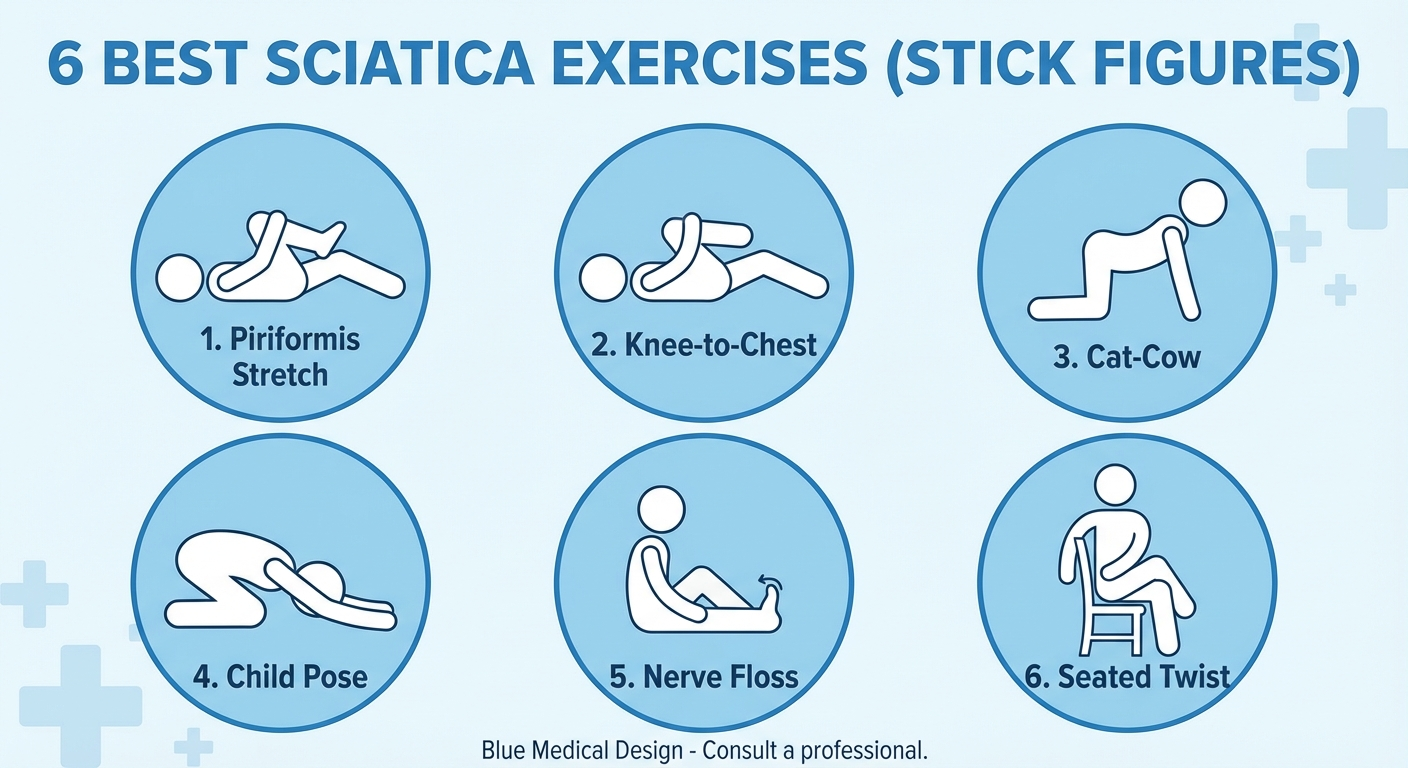
1. Knee-to-Chest Stretch
Target: Lower back decompression, lumbar flexion Difficulty: Beginner Hold: 20-30 seconds per side | Reps: 3 per side
The knee-to-chest stretch gently opens the lumbar vertebrae, creating more space for compressed nerve roots. It is one of the safest starting exercises during an acute sciatica flare-up.
How to perform:
- Lie on your back on a firm surface with both knees bent and feet flat on the floor.
- Slowly bring one knee toward your chest, clasping your hands behind the thigh (not over the kneecap).
- Keep your opposite foot flat on the floor and your lower back pressed gently into the surface.
- Hold for 20-30 seconds, breathing deeply.
- Slowly return to the starting position and repeat on the other side.
Progression: Once comfortable, try pulling both knees to your chest simultaneously. You can also add a gentle rocking motion side to side while holding both knees.
Common mistake: Lifting your head and shoulders off the floor, which increases spinal flexion pressure. Keep your head resting on the ground.

2. Piriformis Stretch
Target: Piriformis muscle, external hip rotators Difficulty: Beginner Hold: 20-30 seconds per side | Reps: 3 per side
The piriformis muscle sits deep in the buttock, and in many people the sciatic nerve runs directly beneath or even through it. When this muscle becomes tight or spasms, it can compress the nerve and mimic or worsen sciatica symptoms. This stretch directly targets that tension.
How to perform:
- Lie on your back with both knees bent.
- Cross your affected leg over the opposite knee, resting your ankle just above the kneecap.
- Reach both hands around the uncrossed thigh and gently pull it toward your chest.
- You should feel a deep stretch in the buttock of the crossed leg.
- Hold for 20-30 seconds, then switch sides.
Progression: Apply gentle downward pressure on the crossed knee with your elbow to deepen the stretch. You can also perform this stretch while seated in a chair for convenience during the workday.
Common mistake: Pulling too aggressively. The stretch should feel like a deep pull, not sharp pain.
3. Sciatic Nerve Flossing
Target: Sciatic nerve mobility Difficulty: Beginner to Intermediate Reps: 10-15 slow repetitions per side
Nerve flossing (also called nerve gliding) is a technique that helps restore normal movement of the sciatic nerve through the surrounding tissues. When a nerve becomes irritated, it can adhere to muscles and fascia, and flossing gently frees these restrictions.
How to perform:
- Sit upright on the edge of a chair with your feet flat on the floor.
- Straighten the affected leg out in front of you while simultaneously looking up toward the ceiling.
- Then bend the knee back down while tucking your chin to your chest.
- Alternate between these two positions in a slow, rhythmic motion.
- Each cycle should take about 3-4 seconds.
Progression: Increase the range by pointing and flexing your toes as you extend and bend the leg. Add dorsiflexion (pulling toes toward your shin) at the top of the movement to increase the nerve tension slightly.
Common mistake: Moving too quickly. Nerve flossing should be slow and controlled. Fast or jerky movements can further irritate an inflamed nerve.
4. McKenzie Press-Up
Target: Lumbar extension, disc centralization Difficulty: Beginner to Intermediate Hold: 5-10 seconds | Reps: 10
Developed by New Zealand physiotherapist Robin McKenzie, this exercise is particularly effective for sciatica caused by disc herniation. The extension motion helps push disc material anteriorly, away from the nerve root. Many patients experience immediate centralization of symptoms with this movement.
How to perform:
- Lie face down on a firm surface with your hands positioned under your shoulders, as if you are about to do a push-up.
- Keeping your hips and pelvis pressed into the floor, slowly push your upper body up by straightening your arms.
- Allow your lower back to arch. Your hips must stay on the ground.
- Hold the top position for 5-10 seconds, then slowly lower back down.
- Repeat 10 times.
Progression: Start with propping on your elbows (sphinx position) if full extension is too intense. As you improve, hold the top position for longer periods and add sustained holds of 30 seconds.
Common mistake: Lifting the hips off the floor. The goal is lumbar extension, not a yoga cobra pose. Your pelvis must maintain contact with the surface at all times.

5. Cat-Cow Stretch
Target: Spinal mobility, lumbar flexion and extension Difficulty: Beginner Reps: 10-15 slow cycles
Cat-cow is a classic spinal mobility exercise borrowed from yoga. It gently moves the lumbar spine through its full range of flexion and extension, promoting disc nutrition through a pumping action and reducing stiffness in the vertebral joints.
How to perform:
- Start on all fours with your hands directly under your shoulders and knees under your hips.
- Cow: Inhale and drop your belly toward the floor, lifting your head and tailbone toward the ceiling. Allow a gentle arch in your lower back.
- Cat: Exhale and round your spine toward the ceiling, tucking your chin to your chest and your tailbone under.
- Move slowly between these two positions, spending about 3 seconds in each.
- Repeat for 10-15 cycles.
Progression: Add a lateral sway by shifting your hips to each side during the cow phase to incorporate gentle side bending. You can also pause at the midpoint (neutral spine) for 5 seconds to build isometric stability.
Common mistake: Forcing the range of motion. The movement should feel fluid and comfortable. If either extreme causes pain, reduce the arc of movement.
6. Seated Piriformis Stretch
Target: Piriformis muscle, hip external rotators Difficulty: Beginner Hold: 20-30 seconds per side | Reps: 3 per side
This variation of the piriformis stretch is designed for people who find it difficult to get on the floor or who want to stretch during the workday. It provides the same deep buttock stretch in a more accessible position.
How to perform:
- Sit upright in a sturdy chair with your feet flat on the floor.
- Cross the affected leg over the opposite knee so your ankle rests just above the kneecap.
- Keeping your back straight, lean forward from the hips until you feel a stretch deep in the buttock.
- Hold for 20-30 seconds.
- Return to upright and repeat on the other side.
Progression: Use your hand to gently press the crossed knee downward while leaning forward for a deeper stretch. You can also rotate your torso slightly toward the crossed leg.
7. Figure-4 Stretch
Target: Piriformis, glutes, hip external rotators Difficulty: Beginner Hold: 20-30 seconds per side | Reps: 3 per side
The figure-4 stretch is closely related to the supine piriformis stretch but emphasizes a slightly different angle of hip rotation, making it effective for people whose sciatica originates from gluteal muscle tightness rather than pure piriformis compression.
How to perform:
- Lie on your back with both knees bent and feet flat on the floor.
- Place your right ankle on your left knee, forming a "4" shape with your legs.
- Lift your left foot off the floor and thread your right hand through the triangle formed by your legs.
- Clasp both hands behind your left thigh and gently pull toward your chest.
- Hold for 20-30 seconds, then switch sides.
Progression: Straighten the bottom leg toward the ceiling while maintaining the figure-4 position to add a hamstring component to the stretch.
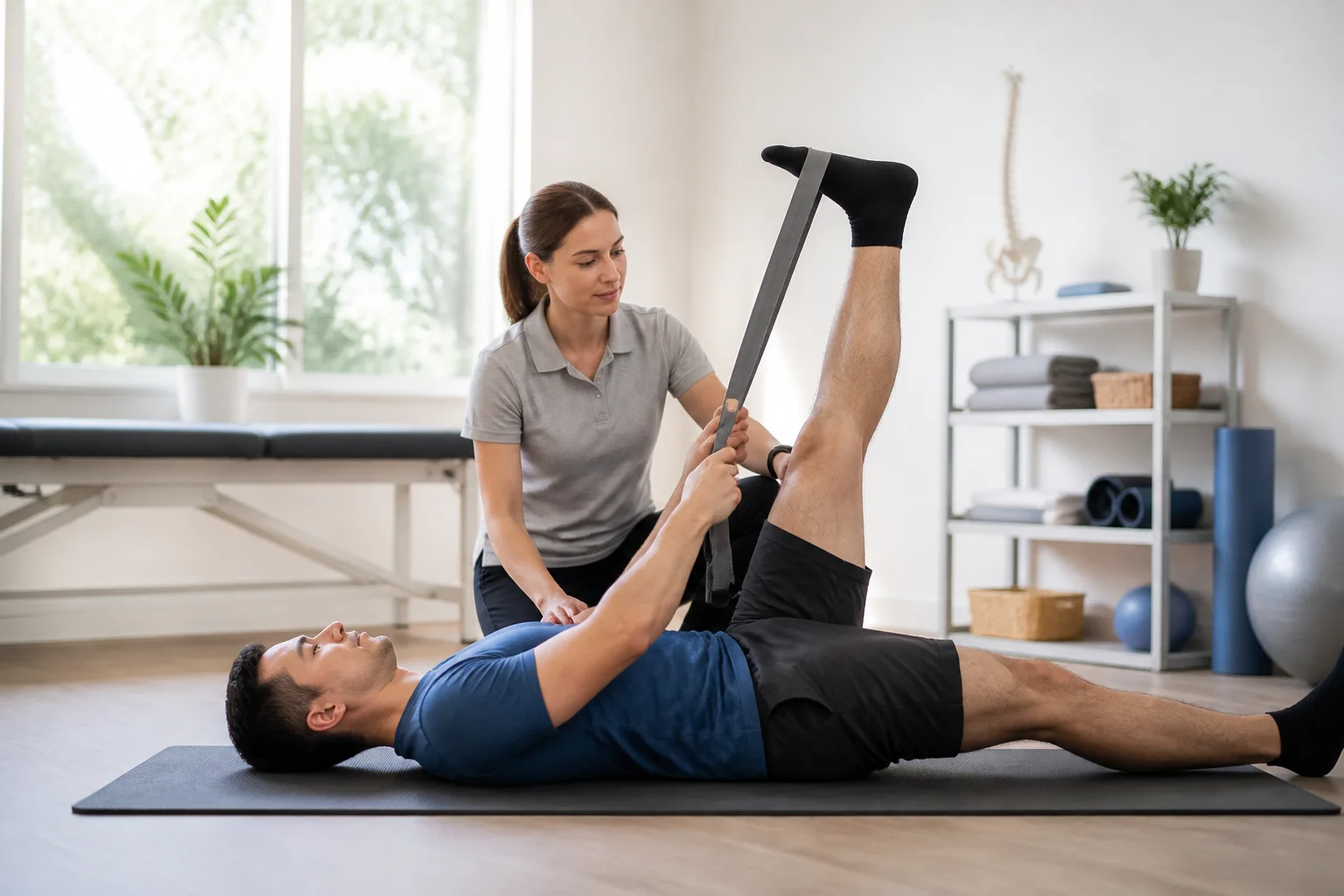
8. Hamstring Stretch
Target: Hamstring muscles, posterior chain Difficulty: Beginner Hold: 20-30 seconds per side | Reps: 3 per side
Tight hamstrings can tilt the pelvis posteriorly, increasing pressure on the lumbar discs and contributing to sciatic nerve irritation. Maintaining hamstring flexibility is a key component of long-term sciatica management.
How to perform:
- Lie on your back with both legs flat.
- Lift the affected leg and loop a towel or resistance band around the ball of your foot.
- Keeping the knee slightly bent (not locked), gently pull the leg toward you using the towel.
- Stop when you feel a comfortable stretch along the back of the thigh.
- Hold for 20-30 seconds, then lower slowly.
Progression: Gradually straighten the knee as flexibility improves. You can also add ankle circles while holding the stretched position to incorporate nerve flossing.
Caution: Never force the leg to a 90-degree angle. For sciatica patients, an aggressive hamstring stretch can increase neural tension and worsen symptoms. Aim for a gentle, tolerable pull.

9. Standing Back Extension
Target: Lumbar extension, postural correction Difficulty: Beginner Hold: 3-5 seconds | Reps: 10
The standing back extension is essentially a vertical version of the McKenzie press-up. It is extremely practical because you can perform it anywhere -- at work, while standing in a queue, or during a walk. It is particularly useful for people whose sciatica worsens with prolonged sitting.
How to perform:
- Stand with your feet shoulder-width apart.
- Place both hands on your lower back, fingers pointing downward.
- Slowly lean backward, using your hands for support, arching through the lower back.
- Hold the top position for 3-5 seconds.
- Return to standing and repeat 10 times.
Progression: Increase the hold time to 10 seconds or perform the movement with hands overhead for added extension.
10. Bird-Dog
Target: Core stability, multifidus activation, spinal endurance Difficulty: Intermediate Hold: 5-10 seconds per side | Reps: 8-10 per side
By Sciatica Spot Editorial Team
How to perform:
- Start on all fours with hands under shoulders and knees under hips. Maintain a neutral spine.
- Simultaneously extend your right arm forward and your left leg backward.
- Keep your hips level -- do not rotate or tilt. Imagine balancing a glass of water on your lower back.
- Hold for 5-10 seconds, then return to the starting position.
- Repeat with the opposite arm and leg.
- Perform 8-10 repetitions per side.
Progression: Draw a small square in the air with your extended hand and foot to challenge balance. You can also add a resistance band around the extended foot for additional strengthening.
Common mistake: Hyperextending the lower back during the movement. Your spine should remain in a neutral position throughout. If your back sags, reduce the range of motion.
11. Lumbar Rotation Stretch
Target: Lumbar rotators, obliques, spinal mobility Difficulty: Beginner Hold: 20-30 seconds per side | Reps: 3 per side
This gentle rotational stretch helps relieve tension in the muscles along either side of the lumbar spine. It can be particularly soothing for sciatica caused by facet joint irritation or generalized lumbar muscle guarding.
How to perform:
- Lie on your back with both knees bent and feet flat on the floor, arms extended to the sides in a "T" position.
- Keeping your knees together, slowly let both knees fall to one side toward the floor.
- Keep both shoulders pressed into the ground.
- Hold for 20-30 seconds, feeling a gentle twist through the lower back.
- Bring your knees back to center and repeat on the opposite side.
Progression: Place a pillow between your knees to maintain hip alignment. As mobility improves, try straightening the top leg for a deeper stretch.
12. Walking
Target: General conditioning, endorphin release, disc nutrition Difficulty: Beginner Duration: 15-30 minutes daily
Walking is perhaps the most underrated sciatica exercise. A 2015 study in the Annals of Internal Medicine found that a structured walking program was as effective as clinic-based physiotherapy for chronic low back pain with sciatica. The rhythmic, low-impact motion promotes disc hydration, increases blood flow to healing tissues, and triggers endorphin release.
How to perform:
- Start with 10-15 minutes of walking on flat terrain at a comfortable pace.
- Maintain an upright posture with your shoulders back and core gently engaged.
- Take moderate strides -- avoid overstriding, which can jar the spine.
- Gradually increase duration by 5 minutes each week until you reach 30-45 minutes.
Progression: Add gentle incline walking (hills or treadmill incline) to increase gluteal activation. Nordic walking poles can help distribute load and improve posture.
Tip: If walking initially aggravates symptoms, try aquatic walking in a pool. The buoyancy reduces spinal load by up to 50%.
Sciatica Exercise Comparison Table
| Exercise | Primary Target | Difficulty | Best For | Equipment Needed | Time Per Session |
|---|---|---|---|---|---|
| Knee-to-Chest | Lumbar decompression | Beginner | Acute flare-ups | Yoga mat | 3 min |
| Piriformis Stretch | Piriformis release | Beginner | Piriformis syndrome | Yoga mat | 4 min |
| Nerve Flossing | Nerve mobility | Beginner-Int. | Nerve adhesions | Chair | 3 min |
| McKenzie Press-Up | Disc centralization | Beginner-Int. | Disc herniation | Yoga mat | 4 min |
| Cat-Cow | Spinal mobility | Beginner | General stiffness | Yoga mat | 4 min |
| Seated Piriformis | Hip rotators | Beginner | Office/workplace use | Chair | 3 min |
| Figure-4 Stretch | Glutes, piriformis | Beginner | Gluteal tightness | Yoga mat | 4 min |
| Hamstring Stretch | Posterior chain | Beginner | Pelvic tilt correction | Towel or band | 4 min |
| Standing Extension | Lumbar extension | Beginner | Post-sitting relief | None | 2 min |
| Bird-Dog | Core stability | Intermediate | Long-term prevention | Yoga mat | 5 min |
| Lumbar Rotation | Spinal rotators | Beginner | Facet joint relief | Yoga mat | 4 min |
| Walking | General conditioning | Beginner | Overall recovery | Comfortable shoes | 15-30 min |
Exercises to Avoid With Sciatica
Not all exercises are appropriate during a sciatica episode. The following movements can worsen nerve compression and should generally be avoided unless specifically cleared by your physiotherapist:
- Heavy deadlifts and barbell squats -- Significant axial loading compresses the discs and can worsen herniation.
- Sit-ups and crunches -- These create high intradiscal pressure and can push disc material posteriorly into the nerve root.
- Toe touches (standing forward fold) -- Combines lumbar flexion with hamstring stretching under load, placing significant tension on the sciatic nerve.
- Leg presses with heavy weight -- The seated position combined with high resistance increases lumbar disc pressure dramatically.
- High-impact activities -- Running on hard surfaces, jumping, and plyometrics create repetitive jarring forces through the spine.
- Prolonged static stretching of the sciatic nerve -- While gentle nerve flossing is beneficial, holding aggressive neural tension stretches for extended periods can inflame an already irritated nerve.
When to return to these activities: Most people can gradually reintroduce heavier exercises 6-12 weeks after symptoms resolve, starting at 50% of their previous training load and progressing by no more than 10% per week.
Pros and Cons: Exercise vs. Other Sciatica Treatments
| Factor | Exercise Therapy | Medication | Epidural Injections | Surgery |
|---|---|---|---|---|
| Effectiveness | High for most causes | Moderate (symptom relief) | Moderate-High (temporary) | High for severe cases |
| Speed of Relief | Gradual (days to weeks) | Fast (hours) | Fast (days) | Varies (weeks to months recovery) |
| Cost | Low to free | Low-Moderate | High | Very High |
| Side Effects | Minimal if done correctly | GI issues, dependency risk | Infection risk, headache | Surgical risks, failed back syndrome |
| Long-term Benefit | Excellent (prevents recurrence) | Poor (no structural change) | Moderate (may need repeating) | Good for appropriate candidates |
| Accessibility | High (home-based) | Requires prescription | Requires specialist | Requires specialist |
| Addresses Root Cause | Yes (in many cases) | No | Partially | Yes (structural correction) |
Pros of Exercise for Sciatica
- No cost or very low cost to start
- Can be done at home without equipment
- Addresses the root cause by improving spinal stability and nerve mobility
- Reduces risk of recurrence by up to 50% according to research
- Improves overall physical and mental health
- No pharmaceutical side effects
- Empowers patients with self-management skills
Cons of Exercise for Sciatica
- Takes longer to produce relief compared to medication or injections
- Requires consistent effort and discipline
- Incorrect form can worsen symptoms
- Not sufficient alone for severe structural problems (e.g., large disc extrusion, cauda equina syndrome)
- Some patients experience temporary increase in symptoms when starting
- Guidance from a qualified physiotherapist is recommended for the initial assessment
4-Week Sciatica Exercise Progression Plan
Week 1: Acute Pain Relief (Perform 2x daily)
Focus on gentle mobility and pain reduction.
- Knee-to-Chest Stretch: 3 x 20-second holds per side
- Piriformis Stretch: 3 x 20-second holds per side
- McKenzie Press-Up: 10 repetitions
- Walking: 10-15 minutes
Week 2: Mobility Restoration (Perform 2x daily)
Add nerve mobility and spinal movement.
- All Week 1 exercises
- Sciatic Nerve Flossing: 10 repetitions per side
- Cat-Cow: 10 cycles
- Hamstring Stretch: 3 x 20-second holds per side
Week 3: Stability Building (Perform 1-2x daily)
Introduce core stability and functional movement.
- All Week 2 exercises
- Bird-Dog: 8 repetitions per side with 5-second holds
- Lumbar Rotation Stretch: 3 x 20-second holds per side
- Walking: 20-25 minutes
Week 4: Strengthening and Prevention (Perform 1x daily)
Progress hold times and add endurance.
- All Week 3 exercises with increased hold times (30 seconds)
- Bird-Dog: 10 repetitions per side with 10-second holds
- Walking: 30 minutes
- Begin reintroducing light daily activities
Important: This progression assumes steady improvement. If you experience a setback at any stage, return to the previous week's program. Pain that worsens or fails to improve after 4 weeks of consistent exercise warrants a reassessment by your healthcare provider.
Yoga and Pilates for Sciatica
Both yoga and Pilates have strong evidence supporting their use for sciatica. A 2017 systematic review in the International Journal of Yoga found that yoga-based interventions reduced pain scores by 49% and disability scores by 44% in patients with sciatica and lower back pain.
Best Yoga Poses for Sciatica
| Pose | Primary Benefit | Hold Time | Caution |
|---|---|---|---|
| Child's Pose | Lumbar decompression | 30–60 sec | None for most patients |
| Cobra Pose | Spinal extension, disc retraction | 15–20 sec | Avoid if extension worsens pain |
| Pigeon Pose | Piriformis and hip flexor stretch | 30–60 sec | Use modifications if hips are tight |
| Cat-Cow | Spinal mobility and segmental motion | 10 reps | Move slowly through neutral range |
| Supine Twist | Rotational mobility | 20–30 sec | Keep twist gentle; stop if leg pain increases |
Seated Spinal Twist
This seated yoga-style rotation mobilizes the facet joints of the lumbar spine and stretches muscles along the spine that may contribute to nerve compression.
How to perform:
- Sit on the floor with both legs extended.
- Bend the right knee and place the right foot on the outside of the left knee.
- Place your left elbow on the outside of your right knee.
- Gently twist your torso to the right, looking over your right shoulder.
- Hold for 20–30 seconds, then repeat on the opposite side.
Caution: Keep the twist gentle. If this exercise increases your leg symptoms, skip it — it may not be appropriate for disc-related sciatica.
Equipment That Helps
While most sciatica exercises require no equipment, a few affordable items can enhance your comfort, form, and results.
Yoga Mat -- A supportive surface is essential for floor-based exercises. A mat that is at least 6mm thick provides adequate cushioning for your spine and joints during stretches and core work.
Foam Roller -- A foam roller helps release tight muscles in the glutes, piriformis, and hamstrings. Gentle rolling before your exercise routine can improve range of motion and reduce muscle guarding around the sciatic nerve.
Resistance Bands -- Useful for assisted hamstring stretching and progressive strengthening exercises. A set of varying resistance levels lets you match the band to your current ability.
Lumbar Support Cushion -- For people whose sciatica worsens with sitting, a lumbar support cushion maintains the natural lordotic curve and reduces disc pressure. Consider using one in your car seat and office chair. Learn more about supportive products in our guide to the best mattress for sciatica.
Frequently Asked Questions
How long does it take for sciatica exercises to work?
Most people begin to notice improvement within 2-4 weeks of consistent, daily exercise. During the first few days, you may experience mild soreness as your body adapts to the movements. Significant improvement typically occurs between weeks 3 and 6. However, if your symptoms are not improving at all after 2 weeks, consult a physiotherapist or physician for a reassessment.
Can I do sciatica exercises every day?
Yes, and in fact daily consistency is the most important factor in recovery. During the acute phase, performing gentle stretches twice daily is recommended. As you progress to strengthening exercises like the bird-dog, once daily is sufficient. Listen to your body and take a rest day if exercises cause a significant increase in symptoms.
Should I stretch or strengthen for sciatica?
Both are important, but the emphasis shifts over time. In the acute phase (first 1-2 weeks), focus primarily on stretching and gentle mobility work such as the knee-to-chest, piriformis stretch, and nerve flossing. As pain decreases, gradually shift toward stabilization and strengthening exercises like the bird-dog and walking. Long-term prevention relies more heavily on strengthening the core, glutes, and spinal stabilizers.
What is the single best exercise for sciatica?
There is no single "best" exercise because sciatica has multiple causes and each person responds differently. However, the McKenzie press-up is among the most widely studied and frequently recommended exercises, particularly for disc-related sciatica. Nerve flossing and the piriformis stretch are close contenders. The best approach is a combination of exercises targeting different aspects of the condition.
When should I stop exercising and see a doctor?
Stop exercising immediately and seek medical attention if you experience any of the following: progressive weakness in your leg or foot, loss of bladder or bowel control (this is a medical emergency called cauda equina syndrome), sudden severe pain that does not respond to any position change, numbness in the groin or inner thighs (saddle anesthesia), or symptoms that are steadily worsening despite 2-4 weeks of consistent exercise.
Is walking good for sciatica?
Walking is one of the most beneficial activities for sciatica recovery. Research published in the Annals of Internal Medicine found that a structured walking program was as effective as supervised physiotherapy for chronic low back pain with sciatica. Walking promotes disc nutrition, increases blood flow, strengthens supporting muscles, and releases endorphins. Start with short walks of 10-15 minutes and gradually increase to 30-45 minutes daily.
Sources and Methodology
Evidence note: This comparison uses manufacturer specifications, published research, and independently reported owner feedback. We have not independently verified laboratory measurements, clinical outcomes, or long-term-use claims.
Sources:
-
Vroomen, P.C., et al. (2000). "Lack of effectiveness of bed rest for sciatica." The New England Journal of Medicine, 342(11), 793-801. This study demonstrated that bed rest provided no clinical advantage over watchful waiting for patients with sciatica, forming the foundation for active treatment approaches.
-
McGill, S.M. (2015). Low Back Disorders: Evidence-Based Prevention and Rehabilitation (3rd edition). Human Kinetics. Dr. McGill's research provides the biomechanical basis for the core stabilization exercises (including the bird-dog) recommended in this article.
-
Machado, L.A.C., et al. (2015). "Effectiveness of walking as an intervention for low back pain and sciatica: A systematic review and meta-analysis." Annals of Internal Medicine. This systematic review confirmed that walking programs produce outcomes comparable to supervised physiotherapy for chronic sciatica.
-
McKenzie, R., & May, S. (2003). The Lumbar Spine: Mechanical Diagnosis and Therapy (2nd edition). Spinal Publications. The foundational text for the McKenzie method of assessment and treatment for disc-related spinal pain.
Methodology: Exercises were selected based on three criteria: (1) support from at least one peer-reviewed study or systematic review, (2) safe applicability for home use without supervision after initial instruction, and (3) coverage of the four key treatment goals -- pain relief, nerve mobility, spinal mobility, and core stability. The progression plan follows the tissue healing timeline and graduated loading principles used in evidence-based physiotherapy practice.
Disclaimer: This article is intended for informational purposes only and does not constitute medical advice. Always consult with a qualified healthcare professional before starting any new exercise program, especially if you have severe or persistent sciatica symptoms.
Visual Guide Gallery