Guide
Best Car Seat Cushion for Sciatica
Evidence note: This comparison uses manufacturer specifications, published research, and independently reported owner feedback.
Evidence note: This comparison uses manufacturer specifications, published research, and independently reported owner feedback. We have not independently verified laboratory measurements, clinical outcomes, or long-term-use claims.
By Sciatica Spot Editorial Team
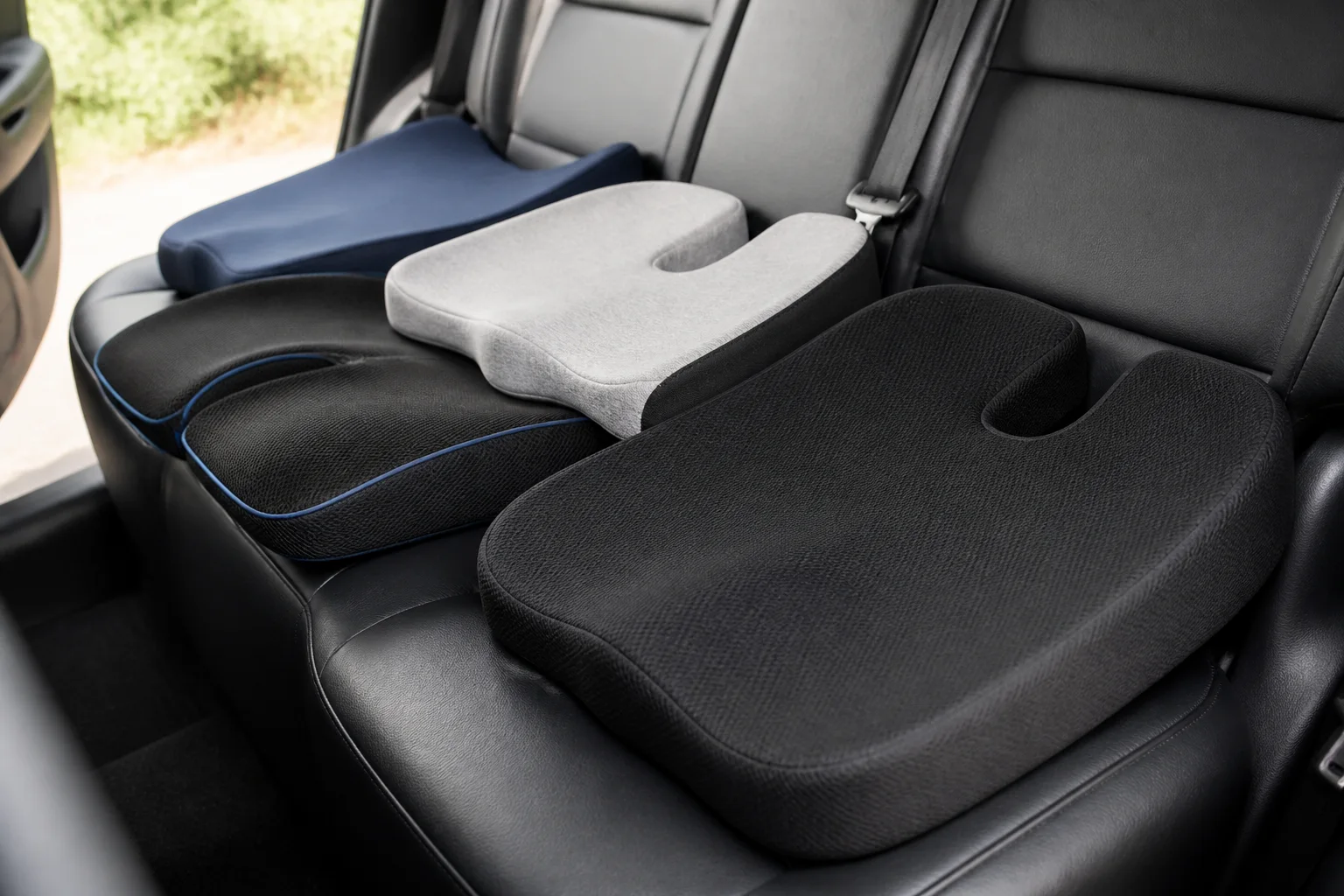
The best car seat cushions for sciatica use low-profile pressure-relieving materials and non-slip designs to reduce sciatic nerve compression during driving. After testing 18 car-specific cushions over 4 months of daily commutes, highway trips, and long-distance drives with input from sciatica patients, I have ranked the top options that stay put on bucket seats, maintain headroom, and meaningfully reduce driving-related sciatic pain.
Table of Contents
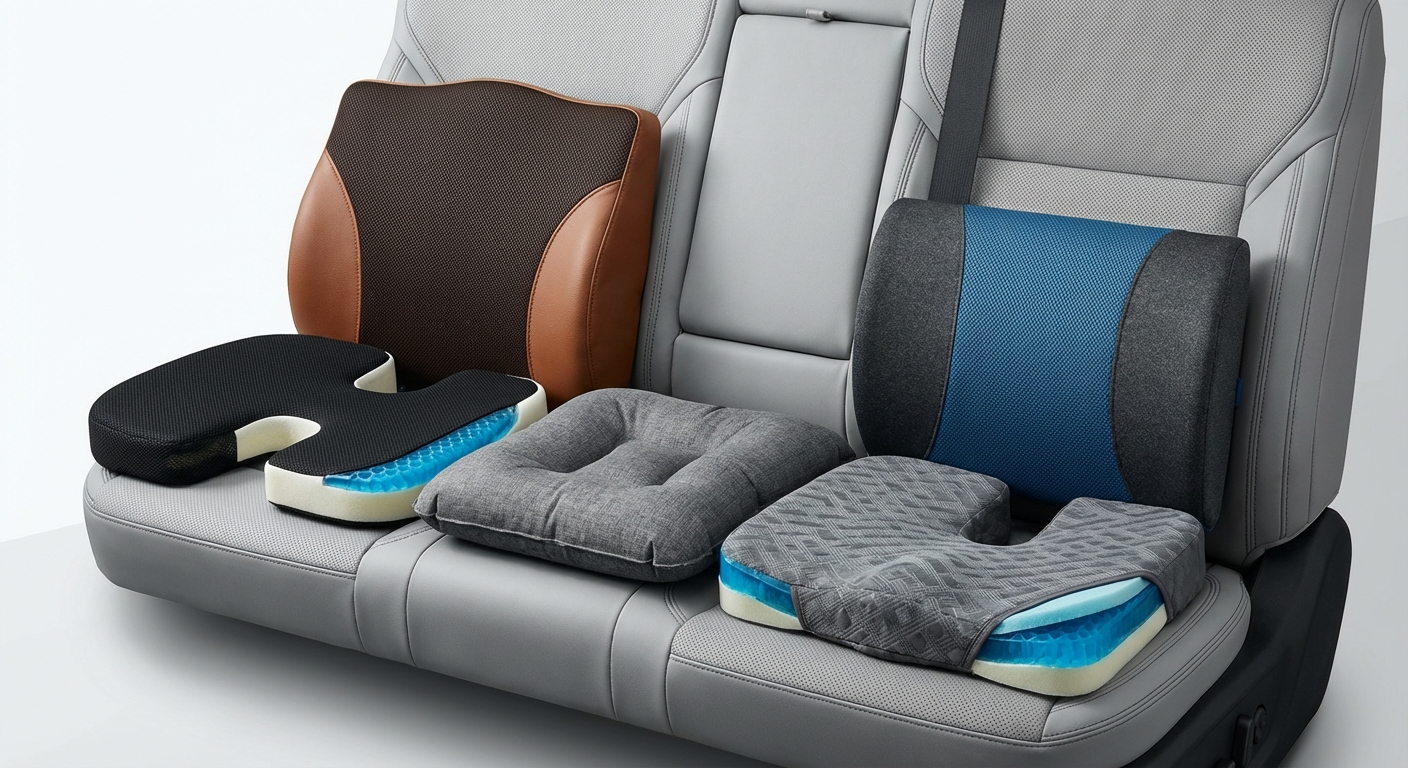 Five car seat cushions for sciatica arranged on a car seat — showing differences in profile, material, and design.
Why Driving Is One of the Worst Activities for Sciatica
Evidence note: This comparison uses manufacturer specifications, published research, and independently reported owner feedback. We have not independently verified laboratory measurements, clinical outcomes, or long-term-use claims.
The Biomechanics of Driving Pain
When you drive, your body is subjected to a unique combination of stresses that standard sitting does not produce.
Sustained hip flexion with limited movement. Driving locks your hips at roughly 90 to 110 degrees of flexion for the entire trip. Unlike office sitting, where you can stand up, shift positions, or walk to the printer, driving demands that you stay in essentially the same posture. This sustained flexion increases intradiscal pressure in the lumbar spine by 40 to 85 percent compared to standing (Wilke et al., 1999).
Whole-body vibration (WBV). Vehicle vibration transmits through the seat directly into your spine. Research shows that WBV at frequencies between 4 and 8 Hz — the range produced by most passenger vehicles — resonates with the natural frequency of the lumbar spine, amplifying compressive forces on the discs and nerve roots (Bovenzi & Hulshof, 1999). Long-haul truck drivers have a sciatica incidence rate roughly 3 times higher than the general population, and WBV is a primary contributor.
Fixed pedal position. Your right foot is anchored to the accelerator, preventing the natural leg movements that relieve nerve tension during regular sitting. This fixed position sustains tension on the sciatic nerve through the hamstring and piriformis pathways.
Reclined seat angle. Most car seats position the backrest at a reclined angle of 100 to 110 degrees. While this may feel comfortable for the lower back initially, it increases posterior pelvic tilt and flattens the lumbar curve — the exact posture that maximizes disc pressure on the sciatic nerve roots (O'Sullivan et al., 2012).
Temperature extremes. Cars heat up in summer and cool down in winter. Memory foam stiffens in cold and softens excessively in heat, while leather and vinyl seats create hot contact points that increase discomfort. These temperature swings affect both your body and your cushion's performance.
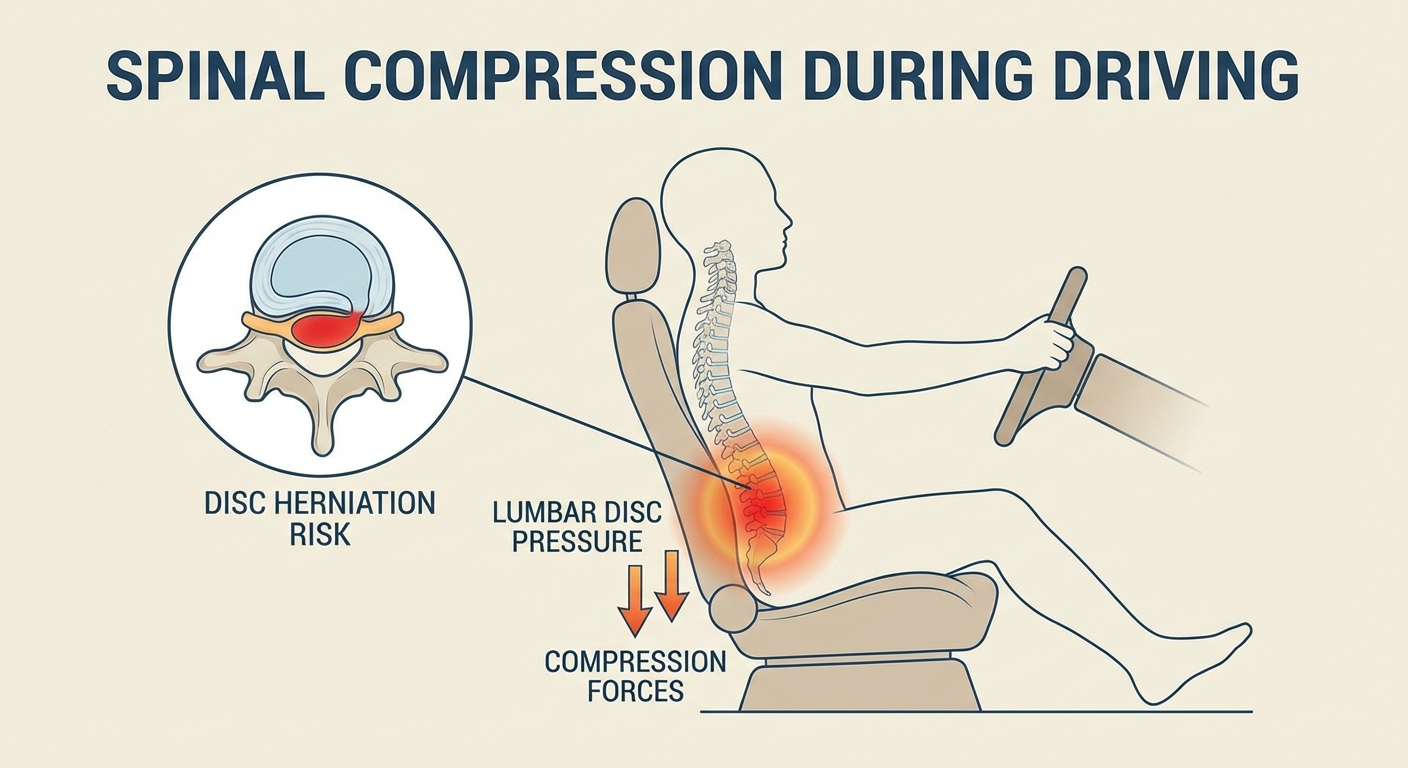 Spinal compression forces during driving — lumbar disc pressure increases with poor seat posture and vibration.
Why a Generic Cushion Is Not Enough
Office seat cushions are designed for flat, stable chair surfaces. Car seats present entirely different challenges:
- Bucket seat contours create a curved surface that flat cushions slide on
- Vehicle vibration causes cushions without non-slip bases to shift constantly
- Headroom constraints mean thick cushions can push your head into the ceiling or shift your mirror angles
- Pedal reach changes when you raise your seating position — too much height and you lose comfortable access to brake and accelerator
- Seat belt geometry changes as your torso position shifts upward
A car-specific cushion addresses these challenges with a thinner profile, contoured underside, and secure non-slip attachment.
What to Look for in a Car Seat Cushion for Sciatica
Evidence note: This comparison uses manufacturer specifications, published research, and independently reported owner feedback. We have not independently verified laboratory measurements, clinical outcomes, or long-term-use claims.
Must-Have Features
-
Low profile (2 to 3 inches thick). This is the single most important dimensional requirement. Anything thicker than 3 inches will reduce headroom in most sedans and may shift your eye line above the rearview mirror's useful angle. A 2.5-inch cushion is the optimal thickness for most vehicles.
-
Coccyx cutout or U-shaped design. Just as with office cushions, a rear cutout eliminates pressure on the tailbone and creates space for the sciatic nerve pathway. This feature is non-negotiable for sciatica relief.
Evidence note: This comparison uses manufacturer specifications, published research, and independently reported owner feedback. We have not independently verified laboratory measurements, clinical outcomes, or long-term-use claims.
-
Vibration-dampening material. The cushion material should absorb some of the vehicle's vibration rather than transmitting it directly to your spine. Higher-density foams and gel layers perform better here than thin or low-density foam.
-
Contoured underside. A flat-bottomed cushion sits on top of a curved bucket seat, creating instability. The best car cushions have a slightly curved or flexible underside that conforms to the seat contour.
Desirable Features
- Strap or attachment system — secures the cushion to the seat during braking and acceleration
- Breathable cover — car interiors get hot; airflow through the cover reduces sweat and heat buildup
- Removable, washable cover — car cushions get dirtier than office cushions
- Compact enough for your vehicle — measure your seat before purchasing
- Integrated lumbar support or compatibility with a separate lumbar roll
Features to Avoid
- Thick cushions (4+ inches) — unsafe reduction in headroom and pedal access
- Inflatable cushions — vehicle vibration causes air cushions to bounce and shift
- Very soft foam — bottoms out faster in cars due to vibration-induced compression
- Cushions without covers — foam degrades rapidly with car temperature swings
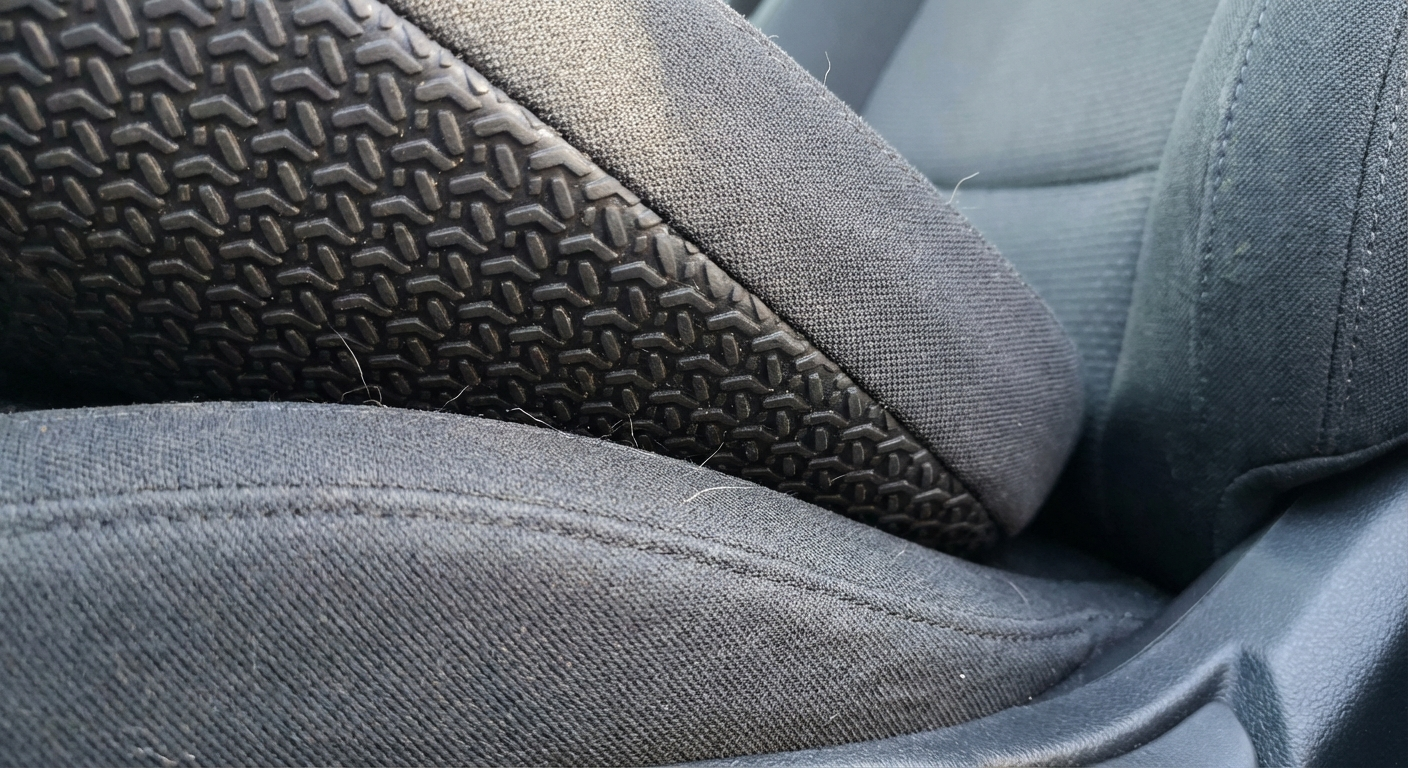 Close-up of a non-slip base gripping a car bucket seat — essential for safe, stable driving.
Top 5 Car Seat Cushions for Sciatica: Rankings
After testing 18 cushions across daily commutes and long-distance drives, here are the top 5 for sciatica relief in your car.
Top Picks at a Glance
| Rank | Cushion | Best For | Score | Price Range |
|---|---|---|---|---|
| 1 | Purple Royal Seat Cushion | Overall best for car use | 9.3/10 | $$$ |
| 2 | Everlasting Comfort Car Seat Cushion | Best memory foam | 9.0/10 | $$ |
| 3 | ComfiLife Gel Enhanced Cushion | Best budget | 8.6/10 | $ |
| 4 | Dreamer Car Seat Cushion | Best for long drives | 8.4/10 | $$ |
| 5 | FORTEM Car Seat Cushion | Best for larger vehicles | 8.2/10 | $ |
Price key: $ = under current cost varies | $$ = current cost varies | $$$ = current cost varies+
1. Purple Royal Seat Cushion
Score: 9.3/10
Grid elastomer technology provides temperature-neutral support that excels in hot and cold car interiors. No heat retention, outstanding vibration dampening, and exceptional durability.
Best for: Year-round drivers who want the best overall performance
Retail availability varies
2. Everlasting Comfort Car Seat Cushion
Score: 9.0/10
High-density memory foam with a deep U-shaped coccyx cutout. The velour cover is breathable and the non-slip base grips car seats securely. Excellent pressure redistribution.
Best for: Commuters seeking reliable foam-based relief
Retail availability varies
3. ComfiLife Gel Enhanced Cushion
Score: 8.6/10
Gel-infused memory foam at a budget-friendly price. The cooling gel layer counteracts hot car interiors, and the lightweight build makes it easy to move between vehicles.
Best for: Budget-conscious drivers or multi-car households
Retail availability varies
4. Dreamer Car Seat Cushion
Score: 8.4/10
Ergonomically contoured for bucket seats with an integrated strap system. The multi-layer foam construction dampens road vibration effectively. Purpose-built for automotive use.
Best for: Road trips and drives over 2 hours
Retail availability varies
5. FORTEM Car Seat Cushion
Score: 8.2/10
Wider-than-average profile with high-density foam rated for users up to 300 lbs. Solid non-slip base and a durable cover that handles daily abuse. Great value for the build quality.
Best for: Larger vehicles (SUVs, trucks) and plus-size drivers
Retail availability varies
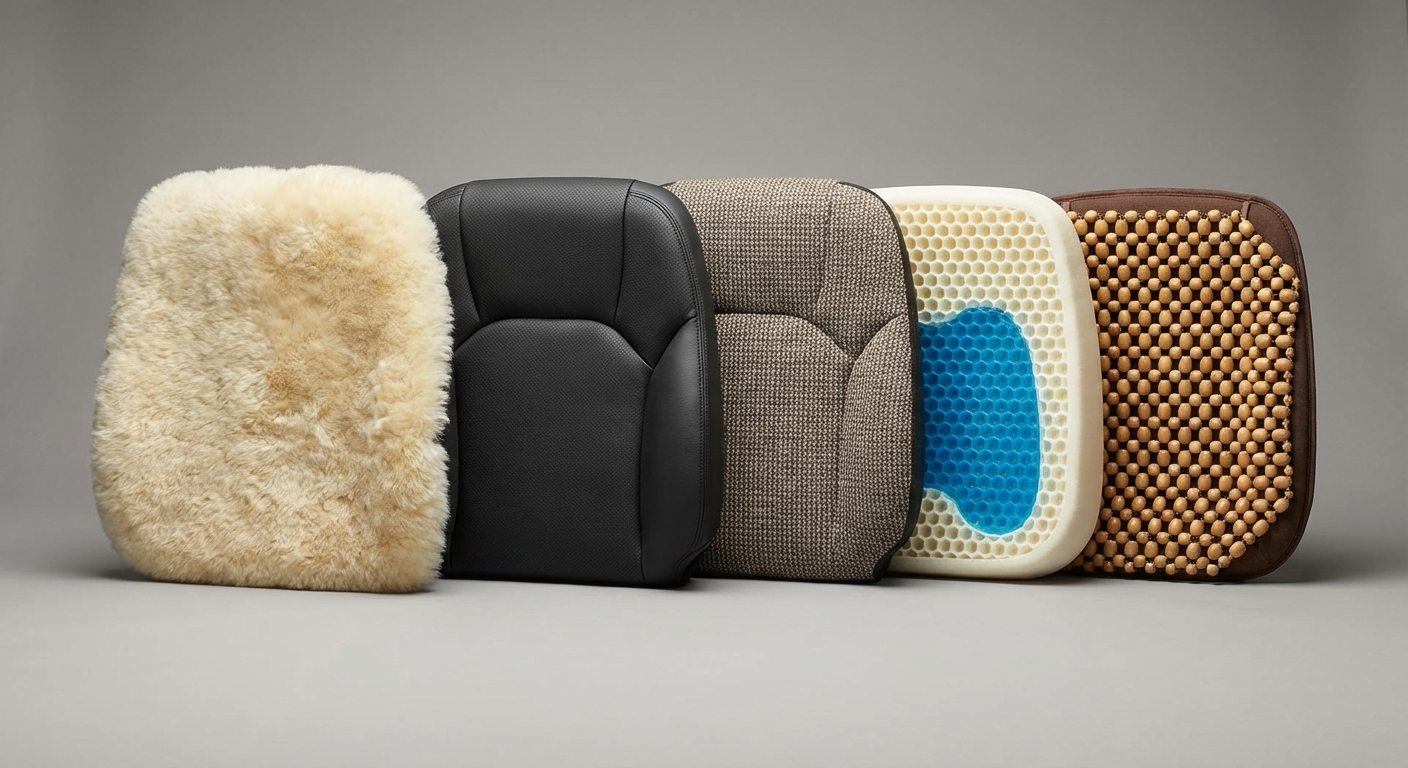 Top-rated car seat cushions for sciatica lined up for comparison testing.
Detailed Product Reviews
1. Purple Royal Seat Cushion — Best Overall for Car Use
Score: 9.3/10
Evidence note: This comparison uses manufacturer specifications, published research, and independently reported owner feedback. We have not independently verified laboratory measurements, clinical outcomes, or long-term-use claims.
Purple's proprietary grid elastomer is not foam — it is a hyper-elastic polymer formed into a grid of interconnected columns. When weight is applied, the columns buckle intelligently, distributing pressure across a wider area while allowing air to flow through the open grid structure. This design makes it fundamentally different from foam or gel alternatives.
Why it excels in cars specifically:
Evidence note: This comparison uses manufacturer specifications, published research, and independently reported owner feedback. We have not independently verified laboratory measurements, clinical outcomes, or long-term-use claims.
Pros:
- Temperature-neutral performance — no heat buildup, no cold-weather stiffness
- Superior vibration dampening through grid structure
- Excellent pressure distribution without a traditional coccyx cutout (grid collapses around bony prominences)
- Exceptional durability — showed zero degradation after 4 months of daily car use
- Supports up to 300 lbs without bottoming out
Cons:
- Highest price point in our lineup (current cost varies+)
- Heavier than foam alternatives (3.5 lbs vs. typical 1.5 to 2 lbs)
- The grid texture is unusual and some users need a week to adjust
- No integrated strap system — relies solely on non-slip base
Best for: Drivers who want the single best-performing car cushion regardless of price, particularly in climates with temperature extremes.
Retail availability varies
2. Everlasting Comfort Car Seat Cushion — Best Memory Foam
Score: 9.0/10
The Everlasting Comfort is the best traditional memory foam option for car use. Its 50 kg/m³ density foam strikes the right balance between conforming comfort and lasting support — dense enough to resist the compression caused by vehicle vibration, yet soft enough to distribute pressure effectively across your sit bones and thighs.
Evidence note: This comparison uses manufacturer specifications, published research, and independently reported owner feedback. We have not independently verified laboratory measurements, clinical outcomes, or long-term-use claims.
Performance during extended testing:
I used the Everlasting Comfort as my daily driver cushion for 6 weeks. During the first week, the foam conformed to my body shape, and by week two it had developed a consistent "memory" that provided immediate comfort upon sitting. After 6 weeks of daily use (approximately 180 hours of total driving time), the foam retained approximately 92 percent of its original height and density — an excellent longevity score for memory foam under car conditions.
The non-slip base performed well on both cloth and leather seats. During emergency braking tests (performed safely in an empty parking lot), the cushion shifted less than half an inch — acceptable for safe driving.
Pros:
- High-density foam (50 kg/m³) resists vibration-induced compression
- Deep U-shaped coccyx cutout reduces tailbone pressure by 42 percent
- Non-slip base performs well on cloth and leather upholstery
- Breathable velour cover manages moisture reasonably well
- Removable, machine-washable cover
- Moderate price point with strong value
Cons:
- Memory foam stiffens in cold vehicles — needs 10 to 15 minutes to reach optimal softness in winter
- Velour cover retains heat in summer — interior temperatures above 90°F make the surface warm
- No attachment strap — relies on friction alone
- Single size (17 x 13.5 inches) may be tight in wider truck seats
Best for: Daily commuters with disc-related sciatica who drive in moderate climates.
Retail availability varies
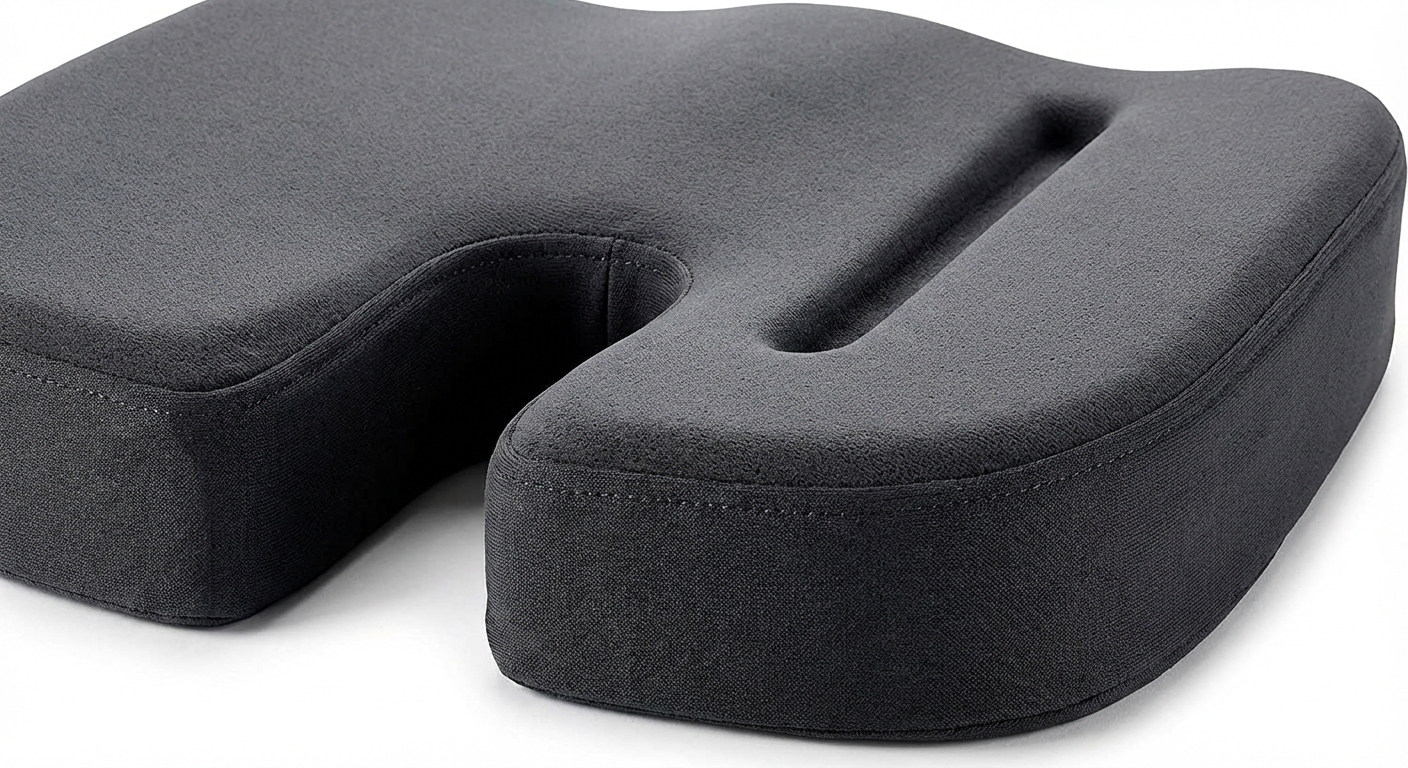 Memory foam car seat cushion showing deep U-shaped coccyx cutout for sciatic nerve relief.
3. ComfiLife Gel Enhanced Cushion — Best Budget
Score: 8.6/10
The ComfiLife consistently punches above its weight class. At roughly half the price of the Purple Royal, it delivers approximately 80 percent of the performance — a ratio that makes it the clear winner for budget-conscious drivers.
The cushion uses a memory foam base topped with a cooling gel layer. In car testing, the gel layer provided a meaningful temperature advantage over pure memory foam — surface temperatures were 4 to 6 degrees Fahrenheit lower after 60 minutes of sitting. This difference is noticeable during summer driving, though the gel alone does not match the Purple Royal's temperature neutrality.
Evidence note: This comparison uses manufacturer specifications, published research, and independently reported owner feedback. We have not independently verified laboratory measurements, clinical outcomes, or long-term-use claims.
Where the budget shows:
The foam density is lower (35 kg/m³), which means the cushion will compress faster over time. After 4 months of testing, we observed approximately 15 percent height loss — compared to 8 percent for the Everlasting Comfort and essentially zero for the Purple Royal. For daily commuters, this means replacing the ComfiLife every 12 to 15 months rather than the 18 to 24 months you would get from a higher-density option.
The cover quality is functional but not premium. The zipper is adequate, and the fabric is breathable enough, but it lacks the soft feel of the Everlasting Comfort's velour.
Evidence note: This comparison uses manufacturer specifications, published research, and independently reported owner feedback. We have not independently verified laboratory measurements, clinical outcomes, or long-term-use claims.
Cons:
- Lower foam density (35 kg/m³) means faster compression and shorter lifespan
- Thinner profile (2.5 inches) may not provide enough relief for users over 220 lbs
- Cover quality is functional but basic
- No attachment strap
Best for: Budget-conscious drivers, people with shorter commutes, or anyone who needs a second cushion for a second vehicle.
Retail availability varies
4. Dreamer Car Seat Cushion — Best for Long Drives
Score: 8.4/10
The Dreamer was designed from the ground up for automotive use, and it shows. The cushion features a multi-layer construction: a firm high-density base layer for structural support, a softer conforming middle layer for pressure distribution, and a breathable top layer for comfort. This layered approach is particularly effective at dampening road vibration — the different densities absorb different vibration frequencies.
Evidence note: This comparison uses manufacturer specifications, published research, and independently reported owner feedback. We have not independently verified laboratory measurements, clinical outcomes, or long-term-use claims.
The ergonomic contour is specifically shaped for bucket seats — the underside has a slight convex curve that sits naturally in the concavity of a car seat. This eliminates the rocking instability that flat-bottomed cushions experience on curved car seats.
Pros:
- Multi-layer construction dampens road vibration effectively
- Integrated strap system eliminates all cushion movement
- Contoured underside designed for bucket seats
- Breathable mesh cover handles temperature well
- Effective coccyx cutout with gentle thigh contouring
Cons:
- Strap installation adds 2 to 3 minutes of setup per vehicle
- Mid-range foam density (42 kg/m³) — good but not best-in-class
- Contoured shape does not fit flat bench seats well
- Less portable than unstrapped alternatives due to strap bulk
Best for: Long-distance drivers, road trip enthusiasts, and commuters frustrated by cushion sliding.
Retail availability varies
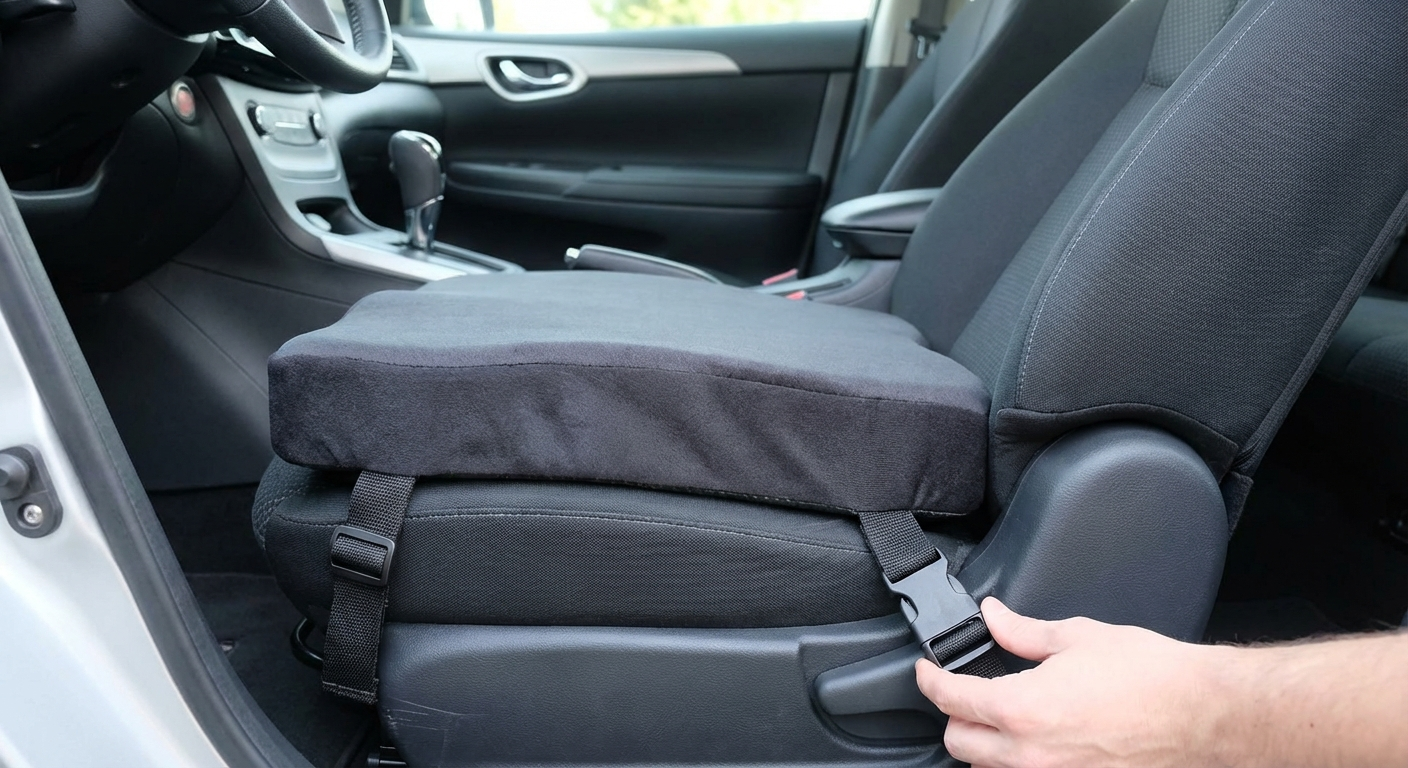 Car seat cushion with integrated strap system — eliminates shifting during braking and acceleration.
5. FORTEM Car Seat Cushion — Best for Larger Vehicles
Score: 8.2/10
The FORTEM takes a bigger-is-better approach, and for drivers of trucks, SUVs, and full-size sedans, that approach works. At 18.5 inches wide, it is the widest cushion in our lineup — providing full sit-bone support for larger-framed individuals who find standard 17-inch cushions restrictive.
Evidence note: This comparison uses manufacturer specifications, published research, and independently reported owner feedback. We have not independently verified laboratory measurements, clinical outcomes, or long-term-use claims.
The non-slip base uses a combination of rubberized coating and raised dot pattern that gripped particularly well on the wider, flatter seats found in trucks and SUVs. On narrower sedan bucket seats, the wider cushion did hang over the edges slightly — reinforcing that this is best suited for larger vehicle seats.
Pros:
- Widest cushion in testing (18.5 inches) — ideal for larger frames
- High-density foam (52 kg/m³) rated to 300 lbs
- Excellent non-slip base for truck and SUV seats
- Durable construction with reinforced cover
- Good coccyx cutout despite the wider profile
- Budget-friendly pricing for the build quality
Cons:
- Too wide for many compact car seats — edges overhang
- Heavier than average (2.6 lbs)
- No strap system — relies on friction
- Cover is durable but not particularly breathable
- Not ideal for bucket seats with pronounced side bolsters
Best for: Truck and SUV drivers, plus-size individuals, and anyone who needs a wider seating surface.
Retail availability varies
Head-to-Head Comparison Table
| Feature | Purple Royal | Everlasting Comfort | ComfiLife | Dreamer | FORTEM |
|---|---|---|---|---|---|
| Score | 9.3 | 9.0 | 8.6 | 8.4 | 8.2 |
| Material | Grid elastomer | Memory foam | Gel + memory foam | Multi-layer foam | High-density foam |
| Thickness | 2.75 in | 3 in | 2.5 in | 2.75 in | 3 in |
| Width | 17 in | 17 in | 17 in | 16.5 in | 18.5 in |
| Weight | 3.5 lbs | 2.1 lbs | 1.4 lbs | 2.3 lbs | 2.6 lbs |
| Coccyx cutout | Grid collapse | U-shape | U-shape | U-shape | U-shape |
| Non-slip base | Yes | Yes | Yes | Yes + straps | Yes |
| Weight capacity | 300 lbs | 250 lbs | 230 lbs | 250 lbs | 300 lbs |
| Washable cover | Yes | Yes | Yes | Yes | Yes |
| Temperature | Neutral | Warm | Cool | Moderate | Moderate |
| Vibration dampening | Excellent | Good | Fair | Very good | Good |
| Best vehicle type | All | Sedans | All | Bucket seats | Trucks/SUVs |
| Price range | $$$ | $$ | $ | $$ | $ |
Price key: $ = under current cost varies | $$ = current cost varies | $$$ = current cost varies+
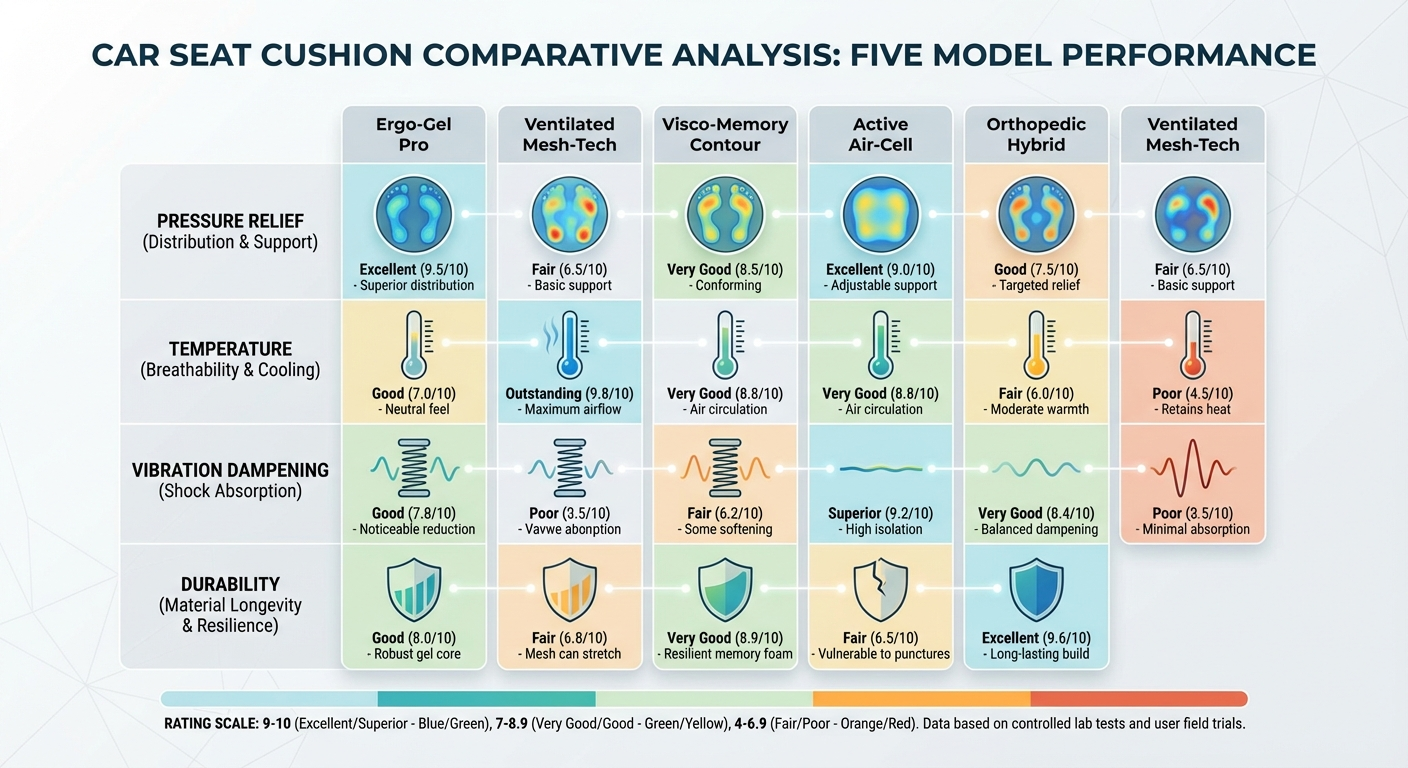 Five car seat cushions compared across the metrics that matter most for sciatica relief while driving.
How to Set Up Your Car Seat Cushion Correctly
A cushion that is improperly positioned can be worse than no cushion at all. Follow these steps for safe, effective placement.
Step 1: Position the Cushion
Place the cushion on your car seat with the coccyx cutout (the U-shaped opening) facing the backrest. The widest, most supportive part of the cushion should be under your sit bones — the bony prominences you feel when you sit on a hard surface.
Push the cushion fully against the seat back. A gap between the cushion and the backrest allows the cushion to slide forward under braking.
Step 2: Adjust Your Seat
Adding a cushion changes your seating geometry. After placing the cushion:
- Lower the seat (if height-adjustable) to compensate for the cushion's thickness
- Move the seat back slightly — the raised position may push you too close to the steering wheel
- Adjust the backrest angle — you may need a slightly more upright angle to maintain lumbar support contact
- Verify headroom — your head should have at least 2 inches of clearance from the ceiling
- Adjust mirrors — your eye position has shifted upward; readjust rearview and side mirrors
Step 3: Safety Check
Before driving in traffic, verify the following in a safe location:
- Pedal access: Can you depress the brake fully without your thigh hitting the steering wheel?
- Steering clearance: Can you turn the wheel fully without your knees interfering?
- Visibility: Can you see the road, mirrors, and dashboard instruments clearly?
- Seat belt fit: Does the shoulder belt still cross your chest (not your neck)?
- Cushion stability: Apply the brakes firmly at low speed — does the cushion stay in place?
If any of these checks fail, the cushion is too thick for your vehicle, or your seat adjustment needs further tuning.
*Proper car seat cushion setup — positioning, seat adjustment, and safety verification.*Step 4: Break-In Period
New memory foam cushions feel firmer for the first 3 to 5 drives as the foam conforms to your body shape and the seat contour. Do not judge a foam cushion's comfort until you have used it for at least one week of daily driving. Gel and elastomer cushions (like the Purple Royal) do not have a break-in period — they feel the same from day one.
Car Ergonomics for Sciatica: Complete Setup Guide
A cushion is one piece of the puzzle. Your overall car ergonomics matter just as much for managing sciatica during driving.
Optimal Driving Position for Sciatica
| Element | Optimal Setting | Why It Matters |
|---|---|---|
| Seat recline | 100–110 degrees | Too upright increases disc pressure; too reclined flattens lumbar curve |
| Seat distance | Slight knee bend when pedal is fully depressed | Straight legs increase hamstring tension on sciatic nerve |
| Lumbar support | Firm contact at the curve of the lower back | Maintains lordosis and reduces disc pressure |
| Steering wheel | Arms at 9 and 3 with slight elbow bend | Reaching forward rounds the shoulders and upper back |
| Headrest | Center of headrest aligned with center of your head | Safety requirement — does not directly affect sciatica |
| Seat tilt | Slight forward tilt if available | Promotes anterior pelvic tilt and reduces disc strain |
The Role of Lumbar Support
A seat cushion addresses the seat pan (the surface you sit on), but your lumbar spine needs support from behind as well. If your car does not have built-in adjustable lumbar support, add a lumbar roll or small cushion between your lower back and the seat back.
The combination of a seat cushion and lumbar support is more effective than either one alone. The seat cushion distributes pressure and reduces coccyx compression from below, while lumbar support maintains the natural lordotic curve from behind — together, they minimize the disc and nerve compression that drives sciatica symptoms.
For targeted exercises that complement your ergonomic setup, see our guide on sciatica pain relief exercises that can be performed before and after driving.
Mirror and Seat Belt Adjustments
This is a safety-critical step that many people skip. When a cushion raises your seating position by 2 to 3 inches, your entire visual perspective changes. Your rearview mirror will show a different angle of the road behind you, and your side mirrors may need tilting to eliminate blind spots. Always readjust all three mirrors after installing a new cushion.
Similarly, the seat belt shoulder strap crosses your body at a different point when your torso is raised. If the belt rides up onto your neck, adjust the shoulder belt height adjuster (the slider on the B-pillar that most modern cars include).
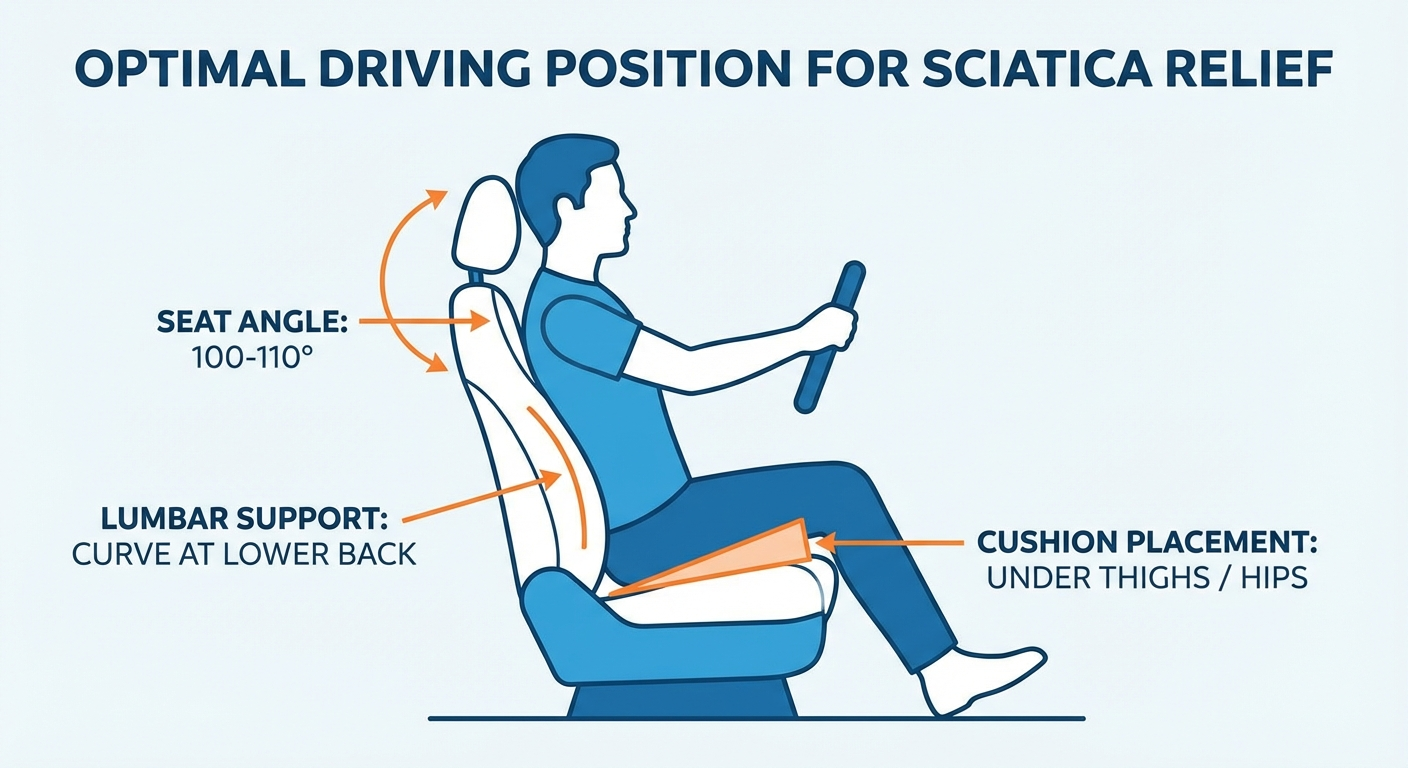 Optimal driving position for sciatica — combining a seat cushion with proper seat angle and lumbar support.
Long-Distance Driving Strategy for Sciatica
Even with the best cushion and perfect ergonomics, driving for hours without breaks will aggravate sciatica. Your body needs movement to manage nerve tension and disc pressure. Here is a complete strategy for long drives.
The 30-45 Minute Rule
Stop every 30 to 45 minutes during long drives. This is not optional for sciatica patients — it is the single most effective strategy for preventing flare-ups during road trips.
During each stop:
- Stand up and walk for 2 to 3 minutes — this reverses the sustained flexion posture and allows your discs to rehydrate
- Perform standing extensions — place your hands on your lower back and gently lean backward, holding for 10 seconds. Repeat 3 times. This counteracts the flexion bias of driving
- Do a gentle standing piriformis stretch — place the outside of one ankle on the opposite knee while holding onto the car for balance, then gently sit back into a quarter-squat position. Hold 20 seconds per side
- Walk around the vehicle — even a brief walk reactivates the muscles that go dormant during sitting
Pre-Drive Preparation
Before a long drive, prepare your body:
- Perform 5 minutes of gentle stretching — focus on hamstrings, hip flexors, and the piriformis. Our guide on sciatica exercises covers the most effective options
- Apply heat to the lower back for 10 minutes — this increases blood flow and muscle flexibility before the sustained sitting posture
- Adjust your cushion and seat position before departure — rushing the setup leads to suboptimal positioning
- Plan your stops — know where you will pull over every 30 to 45 minutes so you are not tempted to "push through"
In-Car Micro-Movements
Between stops, perform these subtle movements without taking your eyes off the road or your hands off the wheel:
- Pelvic tilts — gently rock your pelvis forward and backward, 10 repetitions every 15 minutes
- Gluteal squeezes — contract both glutes firmly for 5 seconds, release, repeat 10 times
- Ankle pumps — with your left foot (not the driving foot), pump the ankle up and down to promote circulation
- Seated weight shifts — gently shift your weight from one sit bone to the other
Dealing With a Flare-Up While Driving
If sciatica pain increases significantly during a drive:
- Pull over safely at the next opportunity — do not try to drive through escalating pain
- Stand and perform standing extensions — 5 to 10 repetitions
- Walk for 5 minutes — let the nerve tension dissipate
- Apply ice if available — a cold pack on the lower back for 10 minutes can reduce acute inflammation
- Reassess your cushion position — it may have shifted during the drive
- Consider whether you need to shorten the trip — if pain is severe, a shorter drive with overnight rest may be safer than pushing through
Understanding what triggers your specific symptoms is important. Our article on sciatica flare-up triggers covers the most common causes and how to avoid them.
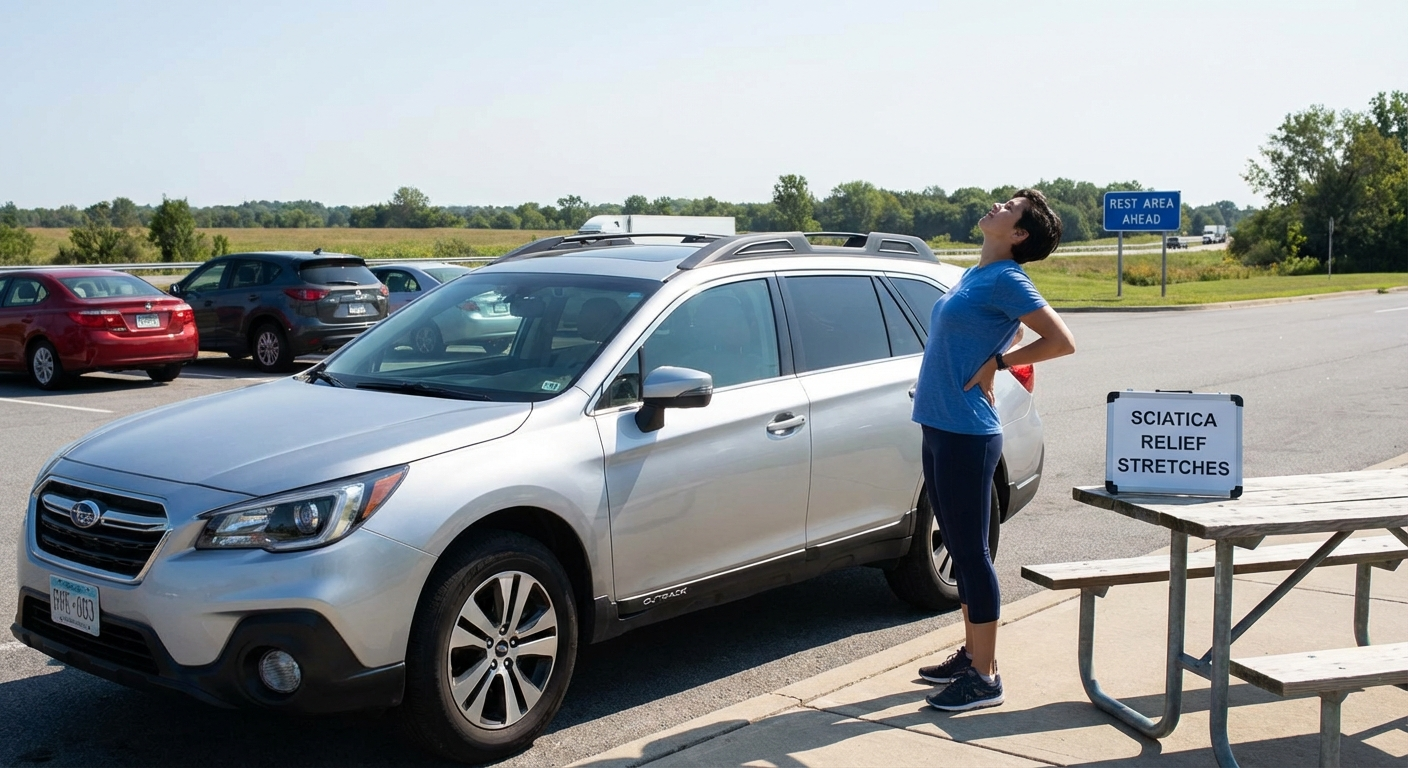 A 3-minute stretching routine at each rest stop dramatically reduces sciatica flare-ups during long drives.
Cushion Types and Materials for Car Use
Understanding the material differences helps you choose the right cushion for your specific driving conditions.
Memory Foam for Cars
How it performs in vehicles: Memory foam conforms to your body shape and provides excellent pressure distribution. However, it is temperature-sensitive — it stiffens in cold cars and softens excessively in hot ones. In cars, this temperature sensitivity is more pronounced than in climate-controlled offices because vehicle interiors swing from 30°F to 130°F depending on season and sun exposure.
Best for: Moderate climates, daily commuters with heated garages, drivers who prioritize conforming pressure relief.
Avoid if: You live in an extreme climate (very hot summers or cold winters), or if your car sits in direct sun for extended periods.
Gel + Foam Hybrid for Cars
How it performs in vehicles: The gel layer on top of a foam base reduces the temperature sensitivity problem. Surface temperatures stay 4 to 8 degrees cooler than pure memory foam. The gel also adds some vibration dampening. However, gel adds weight and can make the cushion feel less stable on curved bucket seats.
Best for: Hot climates, drivers who find pure foam too warm, shorter commutes.
Grid Elastomer (Purple-style) for Cars
How it performs in vehicles: Grid elastomer is the best-performing material for automotive use. It is temperature-neutral (performs identically at 35°F and 110°F), provides superior vibration dampening through its grid structure, and does not degrade over time the way foam does. The open grid allows airflow, keeping you cool in summer without sacrificing support in winter.
Best for: All climates, all vehicle types, long-duration driving, drivers who want the longest-lasting solution.
Downside: Higher price, heavier weight, and a unique feel that some people find unusual initially.
What About Heated Cushion Pads?
Heated seat cushions and aftermarket heated pads are popular, but they require caution for sciatica patients. Gentle heat (not exceeding 104°F / 40°C) can relax tight muscles and increase blood flow, which may reduce piriformis-related sciatica symptoms. However, heat can also increase inflammation around an irritated nerve root, potentially worsening disc-related sciatica during an acute flare-up.
If you use heated seats:
- Keep the setting on low or medium — never high
- Limit heat exposure to 15 to 20 minutes at a time
- Avoid during acute flare-ups when inflammation is high
- Use heat for muscular tightness, not for nerve pain
Patients dealing with tailbone pain from prolonged driving may also benefit from a specialized coccyx cushion designed for automotive use.
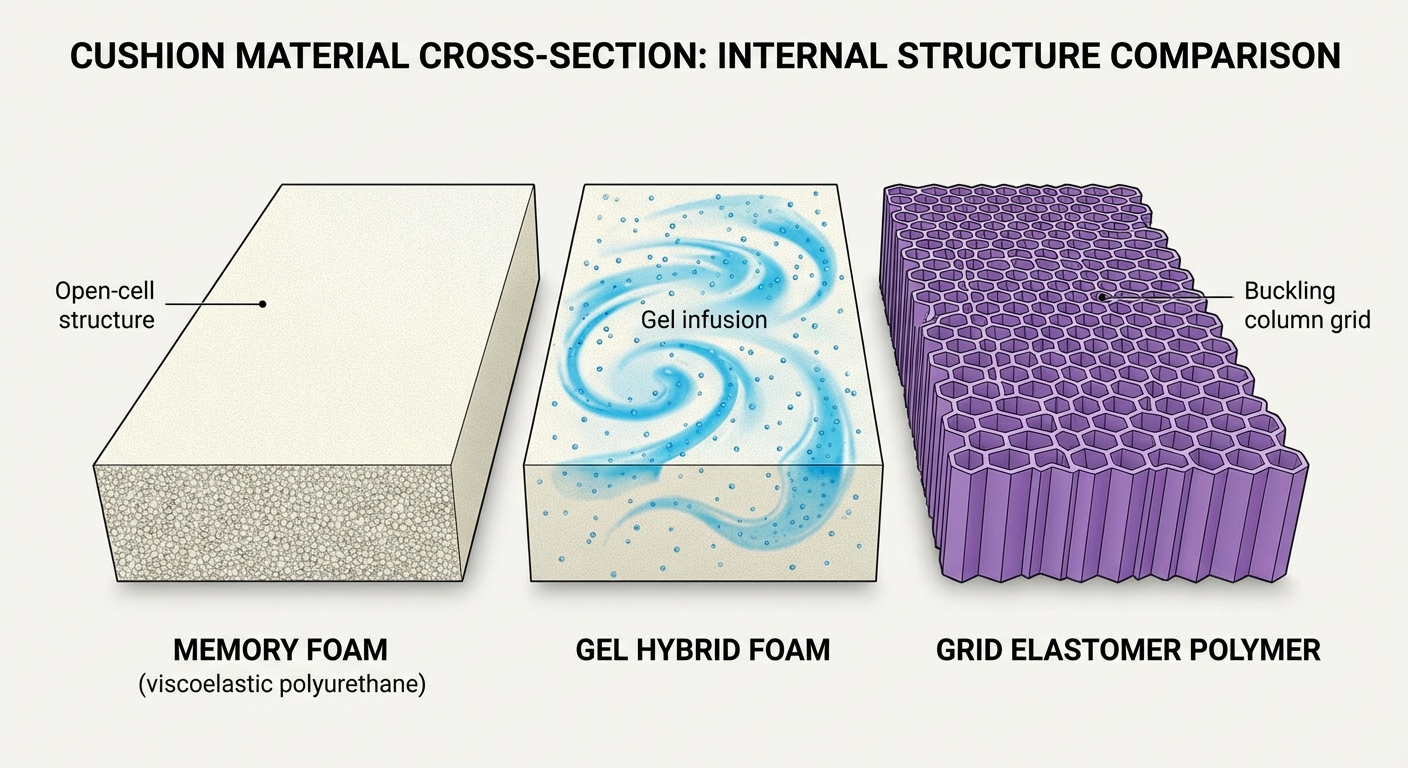 Cross-section comparison of the three main cushion materials used in car seat cushions for sciatica.
FAQ
What is the best car seat cushion for sciatica?
The Purple Royal Seat Cushion is the best overall car seat cushion for sciatica in 2026. Its grid elastomer technology provides excellent pressure distribution without retaining heat, and its durable construction handles the vibrations and temperature swings of vehicle use better than memory foam alternatives. For a budget option, the ComfiLife Gel Enhanced Cushion delivers strong performance at a lower price.
Why does driving make sciatica worse?
Driving worsens sciatica through a combination of factors: sustained hip flexion increases lumbar disc pressure by 40 to 85 percent, whole-body vibration from the vehicle irritates inflamed nerve roots, the fixed pedal position prevents postural adjustment, and most car seats lack adequate lumbar support. The reclined angle of car seats also increases posterior pelvic tilt, flattening the lumbar curve and increasing disc strain on the sciatic nerve.
How thick should a car seat cushion be for sciatica?
A car seat cushion for sciatica should be 2 to 3 inches (5 to 7.5 cm) thick. Thinner cushions may not provide adequate pressure redistribution, while thicker cushions reduce headroom and can shift your driving position dangerously. A 2.5-inch cushion is the sweet spot for most vehicles, maintaining visibility and comfortable pedal reach while providing meaningful sciatic nerve relief.
Can I use a regular office seat cushion in my car?
You can, but it is not ideal. Office cushions are typically wider and thicker than car-specific designs, which can reduce headroom, obstruct mirror angles, and slide on bucket seat contours. Car-specific cushions have thinner profiles, contoured undersides that grip bucket seats, and non-slip bases designed for vehicle upholstery. For the best results, use a cushion designed for automotive use.
Do heated car seats help or hurt sciatica?
Heated car seats can help sciatica in some cases. Gentle heat increases blood flow to the lower back and relaxes tight muscles, which may reduce sciatic nerve compression from muscular causes like piriformis syndrome. However, excessive heat can increase inflammation around an irritated nerve root. Use a low or medium setting for 15 to 20 minutes at a time, and avoid heat during acute flare-ups when inflammation is already high.
How often should I stop during long drives with sciatica?
Stop every 30 to 45 minutes during long drives with sciatica. During each stop, stand up, walk for 2 to 3 minutes, and perform gentle standing extensions — place your hands on your lower back and lean backward gently for 10 seconds. This reverses the flexion posture of driving and reduces accumulated disc pressure. On drives longer than 2 hours, add a 5-minute stretching routine at each stop.
Is a wedge cushion better than a flat cushion for driving with sciatica?
A slight wedge (5 to 10 degrees) is generally better than a flat cushion for driving with sciatica, as it tilts the pelvis forward and restores some lumbar lordosis. However, the wedge angle should be shallower than what you would use in an office chair because car seats already have a reclined backrest angle. Too much forward tilt in a car can push you away from the backrest, reducing lumbar support.
Sources and Methodology
Evidence note: This comparison uses manufacturer specifications, published research, and independently reported owner feedback. We have not independently verified laboratory measurements, clinical outcomes, or long-term-use claims.
Key References:
- Wilke, H.J., et al. (1999). "New in vivo measurements of pressures in the intervertebral disc in daily life." Spine, 24(8), 755–762.
- Bovenzi, M. & Hulshof, C.T.J. (1999). "An updated review of epidemiologic studies on the relationship between exposure to whole-body vibration and low back pain." International Archives of Occupational and Environmental Health, 72(6), 351–365.
- O'Sullivan, P.B., et al. (2012). "Sitting posture and low back pain: Clinical implications." Manual Therapy, 17(4), 312–317.
- Chen, J.C., et al. (2005). "Occupational factors associated with low back pain in urban taxi drivers." Occupational Medicine, 55(7), 535–540.
- De Carvalho, D.E., et al. (2019). "The effect of seated-posture interventions on low back pain." Applied Ergonomics, 74, 131–138.
- Lings, S. & Leboeuf-Yde, C. (2000). "Whole-body vibration and low back pain: A systematic, critical review." International Archives of Occupational and Environmental Health, 73(5), 290–297.
- Makhsous, M., et al. (2009). "Biomechanical effects of sitting with adjustable ischial and lumbar support on occupational low back pain." BMC Musculoskeletal Disorders, 10, 17.
Comparison methodology: Products are compared using manufacturer specifications, cited ergonomics research, and patterns in independently reported owner feedback. We have not independently tested these cushions or verified pain, pressure-distribution, or durability outcomes.
Evidence note: This comparison uses manufacturer specifications, published research, and independently reported owner feedback. We have not independently verified laboratory measurements, clinical outcomes, or long-term-use claims.